
Comment: Operation Spider’s Web
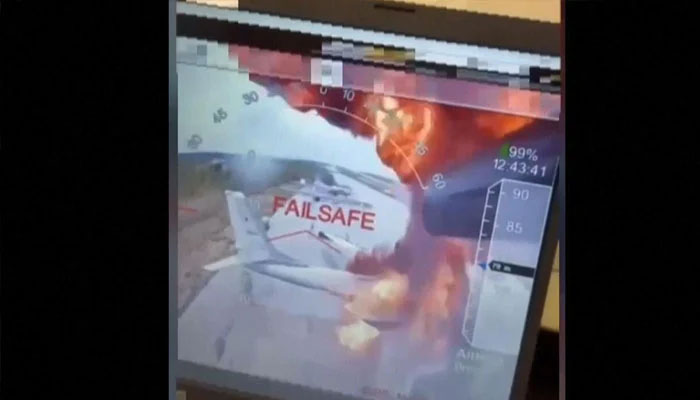
In a coordinated strike operation, Ukraine deployed a total of 117 unmanned aerial vehicles (UAVs)—including UJ-22 Airborne, Beaver, and Liutyi drones—against five high-value Russian air bases: Morozovsk, Akhtubinsk, Orenburg, and Borisoglebsk. These drones, equipped with precision-guidance systems, first-person view (FPV) interfaces, and AI-assisted target acquisition, each cost between $10,000 and $50,000. The swarm assault reportedly resulted in the destruction of approximately 41 Russian aircraft, including Su-34 multirole fighter-bombers, Su-57 fifth-generation stealth fighters, A-50 early warning aircraft and Tu-22M3 long-range strategic bombers—each valued between $20 million and $120 million.
In strategic terms, Ukraine expended roughly $3 million in drone assets to inflict an estimated $3 billion in enemy materiel losses—an asymmetric strike yielding a cost-to-kill ratio of 1:1,000.
Based on reporting from CBS News, Euronews, and RBC-Ukraine, the following is the Execution Summary: “The operation was meticulously planned over an 18-month period by Ukraine’s Security Service (SBU) and personally supervised by President Volodymyr Zelenskyy. Drone components were covertly smuggled into Russian territory and assembled inside wooden sheds mounted on modified transport trucks. These mobile launch platforms were then positioned in close proximity to high-value airbases. At the appointed time, the roofs of the sheds were remotely activated, enabling the drones to launch directly toward their designated targets. This unconventional tactic enabled Ukrainian forces to penetrate deep into Russian airspace, effectively bypassing layered air defense systems and achieving strategic surprise.”
To be certain, the future of warfare will increasingly center on drones and coordinated drone swarms. Operation Spider’s Web offers at least six key lessons. First, air superiority can be undermined from below, as low-flying drones exploit radar blind spots. Second, swarm tactics overload radar systems and exhaust missile interceptors. Third, decoy drones likely absorbed defensive fire, enabling strike drones to reach their targets. Fourth, layered air defense systems—such as Pantsir-S1 and Tor-M2—prove less effective against small, low-altitude threats. Fifth, the use of mobile, truck-mounted micro-factories and launch platforms deep inside enemy territory signals a fundamental doctrinal shift. And sixth, intelligence gathering, subversion, and long-term infiltration were just as critical to success as the drones themselves.
Here are four key lessons for Pakistan: One - Swarm drones yield exponential returns on minimal investment. Pakistan must scale up local production of FPV and kamikaze drones. Two - Rather than entering an arms race with India over jets, tanks, or submarines, Pakistan must focus on asymmetric tools—truck-mounted drone launchers, mobile EW teams, and covert strike units. Three - Precision strikes begin with precise intelligence. Four - Systems like LY-80 and HQ-9P are ineffective against drone swarms. In a nutshell, Pakistan must avoid big-ticket arms races - spend smarter not bigger.







-
 Sarah Chalke Recalls Backlash To 'Roseanne' Casting
 -
 Pamela Anderson, David Hasselhoff's Return To Reimagined Version Of 'Baywatch' Confirmed By Star
 -
 Willie Colón, Salsa Legend, Dies At 75
 -
 Prince Edward Praised After Andrew's Arrest: 'Scandal-free Brother'
 -
 Shawn Levy Recalls Learning Key Comedy Tactic In 'The Pink Panther'
 -
 King Charles Fears More Trouble As Monarchy Faces Growing Pressure
 -
 Inside Channing Tatum's Red Carpet Return After Shoulder Surgery
 -
 Ryan Coogler Brands 'When Harry Met Sally' His Most Favourite Rom Com While Discussing Love For Verstality
 -
 Sarah Pidgeon Explains Key To Portraying Carolyn Bessette Kennedy
 -
 Justin Bieber Rocked The World With Bold Move 15 Years Ago
 -
 Sam Levinson Wins Hearts With Huge Donation To Eric Dane GoFundMe
 -
 Kate Middleton Steps Out First Time Since Andrew Mountbatten-Windsor's Arrest
 -
 Inside Nicole 'Snooki' Polizzi's 'private' Marriage With Husband Jionni LaValle Amid Health Scare
 -
 Germany’s Ruling Coalition Backs Social Media Ban For Children Under 14
 -
 Meghan Markle Shuts Down Harry’s Hopes Of Reconnecting With ‘disgraced’ Uncle
 -
 Liza Minnelli Alleges She Was Ordered To Use Wheelchair At 2022 Academy Awards