
3.4% of total water distribution in Karachi carried out by tankers, City Council told
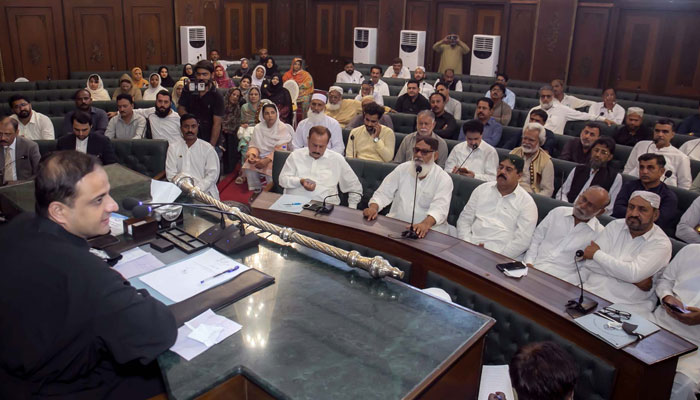
The previously adjourned meeting of the Karachi Metropolitan Corporation (KMC) City Council was reconvened on Friday under the chairmanship of Karachi Mayor Barrister Murtaza Wahab, at the City Council Hall, KMC Headquarters.
The session centred on the city’s pressing water supply and drainage issues, water distribution and other related challenges. Members from various political parties participated in the discussion.
Deputy Mayor Salman Abdullah Murad, parliamentary leaders, Karachi Water & Sewerage Corporation (KWSC) Chief Executive Officer (CEO) Ahmed Ali Siddiqui, Chief Operating Officer (COO) Asadullah Khan and a large number of council members were present during the meeting.
In his address, Wahab proposed the formation of a cross-party committee to address water-related issues, emphasising that this was Karachi’s elected council and must function in a democratic spirit. He congratulated the reinstated CEO and COO of the water corporation and noted that for the first time, KWSC officers were present in the council to respond to the queries of elected representatives.
Acknowledging the city’s water shortage problem, he said the council's input would guide the KWSC's administration. He proposed forming a committee comprising both parliamentary and opposition leaders after the session to devise solutions for the water issue.
Wahab emphasised that operations against illegal hydrants would only be successful with proper oversight. He also announced that the Hub Dam canal project would be completed by August 14.
He stressed the need for enhancing the KWSC’s revenue and called for collective efforts to address Karachi’s water and sewerage challenges, urging the stakeholders to avoid carrying out negative propaganda.
Later, while presiding over the session, the deputy mayor highlighted critical issues related to the K-Electric (KE). He announced that a KE delegation would be invited to the next session of the council. He remarked that the water corporation was actively working to resolve the water issues of Karachi.
The KWSC COO informed the City Council that the K-IV project fell under the jurisdiction of the Water & Power Development Authority. He also reported efforts to reduce water leakage from pipelines.
He added that although 270 pumping and main stations were exempt from loadshedding, issues such as cable faults still occurred. The City Council was informed that major pumping stations were located at Dhabeji, Gharo, Hub and Pipri. Currently, Karachi received 550 million gallons of water per day (MGD), with water tankers accounting for only 3.4 per cent of the total distribution. He noted that the Shah Faisal pumping station, which was damaged by a fire during Ramazan, was restored within three days though water shortage remained severe in the area.
As the chairman of the water corporation, Wahab chose to sit among the members to foster a sense of unity. He described the two-and-a-half-hour participation of the KWSC CEO and COO in the City Council as unprecedented and pledged to end water theft collectively. He pointed out that Karachi needed 1,200 MGD of water, but received only 500 MGD.
The mayor criticised delays in issuing the letter of authorisation for the K-IV project, despite the PC-I being approved in 2022. He mentioned meetings with the prime minister to expedite the K-IV project and discussions with the Pakistan Peoples Party’s (PPP) senior leadership to initiate a new canal from the Hub Dam. The project, he said, had received approval from PPP Chairman Bilawal Bhutto Zardari and the chief minister, and was expected to be completed by August 14, 2025.
He emphasised that this was the first time public servants had been held accountable by the City Council. He called for cooperation to solve the citizens' problems and asked officials to pledge to eliminate the water theft. While noting that action had been taken at 200 locations over the past 15 months, he acknowledged that some illegal hydrants had resurfaced due to external pressures.
He announced that operations against the water theft would resume with support from the union committee chairpersons to help identify the culprits.
Challenging the current population estimates of over 20 million, the mayor lamented that Karachi’s infrastructure had not expanded in 22 years and pointed out that the K-IV project had seen five inaugurations.
He remarked that Karachi was the only city in the country that received water from 125 kilometres away. With increasing demand and limited supply, water shortages are inevitable, he said, calling for open dialogue on the K-IV delays.
He noted that the water corporation’s annual electricity bill stood at Rs18 billion, which was currently paid by the Sindh government. The corporation itself was now covering the KMC's own Rs130 million bill, he explained.
The leader of the opposition in the City Council, Saifuddin Advocate of the Jamaat-e-Islami (JI), said Karachi was facing electricity and water issues. He said that it was initially reported that the K-IV project would be completed this year, but now, reports suggested that the project would be completed by June 2026.
"If we are not getting new water, its fair distribution must be ensured. There are serious public concerns regarding the water corporation,” he said, adding that illegal hydrants were still operating in Karachi.
An 84-inch pipeline burst, after which an investigative report was supposed to be released, but it had not been made public yet, he lamented. He said that although the 84-inch pipeline had been repaired, the water supply had not returned to normal.
A UC chairman from Lyari said that in Lyari, motors at four sewage pumping stations were out of order. He said that tank cleaning work had also not been carried out in Lyari. Water distribution in Lyari, he said, was not fair as corrupt officers in the area had become facilitators of builders’ businesses.
He lamented that the relevant KWSC staff could not even fix a single water leakage. “The executive engineer is colluding with contractors," he alleged. Dil Muhammad, Sanober, Gulfam Haider, Kashifuddin Shamsi, Sanam Baloch, Mumtaz, Shahid Farman and Shazia Imran also spoke during the session, after which the KMC City Council was adjourned for an indefinite period.







-
 24 Dead In Bangladesh After Bus Plunges Into River During Ferry Boarding
 -
 Dana Carvey Recalls Doing 'SNL' Creator Lorne Michaels' Impersonation: 'My First Reaction Is Terror'
 -
 Everything We Know About Taylor Swift And Travis Kelce Honeymoon Plans
 -
 Metformin’s Hidden Brain Pathway Uncovered After 60 Years
 -
 How Dogs Became Man’s Best Friend 15,800 Years Ago: New Study Reveals
 -
 Prince Harry And Meghan Markle Respond To Major Meta And YouTube Ruling
 -
 Why Josh Duhamel Believes His Fans Will Be 'alienated' If He Talks Politics
 -
 Melania Trump Appears With Humanoid Robot At White House
 -
 ‘Addictive By Design’: Meta, YouTube Found Liable In Historic Verdict
 -
 Bruce Willis' Mom Marlene Makes Another Family Amid Son's Battle With Dementia
 -
 Roblox Safety Warning For Parents: Developer Says Kids Need 24/7 Monitoring
 -
 Chelsea Handler Explains Why She Dates Younger Men
 -
 Chappell Roan's Security Guard Takes 'full Responsibility' For His Interaction With Jorginho's Daughter?
 -
 Rosalía Cuts Concert Short Over Sudden Illness, Fans Shocked
 -
 'Buffy' Star Nicholas Brendon's Death Case Takes Massive Turn
 -
 FKA Twigs Takes Legal Stand Against Ex Shia LaBeouf