
Ukrainian envoy opposed to any concessions to Russia
Chuchuk accuses Russia of unlawful killings, arbitrary detentions, and war crimes
ISLAMABAD: On the third anniversary of Russia’s full-scale invasion of Ukraine, Ambassador of Ukraine to Pakistan Markian Chuchuk on Monday called for a peaceful resolution to the conflict—but without offering any concessions to Russia.
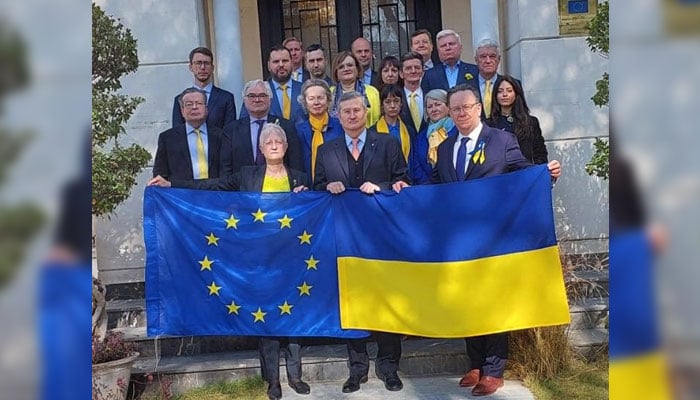
“We welcome any constructive peace initiative, provided it adheres to two principles: no decisions regarding Ukraine shall be made without Ukraine’s involvement, and there must be full adherence to the UN Charter, respecting Ukraine’s sovereignty and territorial integrity. Thus far, Russia has shown no willingness to pursue peace based on international law. Consequently, a just peace cannot arise from concessions to the aggressor but from compelling it to relent through collective strength,” Ambassador Chuchuk told a function held here to mark three years since Russia’s invasion of Ukraine. The event, hosted by the Embassy of Poland and co-sponsored by the embassies of the Czech Republic, France, and Germany, along with the delegation of the European Union, served as a reminder of Ukraine’s resilience and the global consequences of the ongoing war. The Ukrainian envoy said Russia’s unprovoked and illegal war had tested the resilience of the Ukrainian people but failed to break them. “We retain control over 82% of our territory—a testament to the courage of our citizens and the invaluable support of the international community,” he said.
Mr. Chuchuk accused Russia of unlawful killings, arbitrary detentions, and war crimes, saying these actions were deliberate and aimed at erasing Ukrainian identity, culture, and heritage. He asserted that the real reason for the war was simple: Russian imperialism. “Moscow has consistently aimed to erase any sense of Ukrainian national identity. In other words, Russia’s historic goal has always been Ukraine without Ukrainians. It is trying to do the same thing now.” Mr. Chuchuk stressed that while initiating a war was easy, achieving peace was far more challenging. “Ukraine yearns for peace more than any other party. President Zelenskyy’s Peace Formula offers a credible framework to end this conflict. It is the only substantive proposal currently available. Global and transatlantic solidarity is essential to compel Russia to engage in genuine negotiations,” he said. He expressed gratitude to Ukraine’s supporters, including Pakistanis, and said the outcome of the conflict would shape global security, defining the boundary between the rule of law and the right of force. “United, we can secure peace—not just for Ukraine but for all nations striving for a safer, more stable world,” he said. The Embassy of Ukraine also launched a cultural initiative, “Culture vs. War,” featuring a documentary and a photography exhibition by noted Ukrainian artists Kostiantyn and Vlada Liberov and Serhii Mykhalchuk. The exhibition highlights the human and cultural cost of the war. Ambassador of Poland Maciej Pisarski said Russia’s invasion of Ukraine had destroyed peace in Europe and endangered food and energy security. He said Ukraine was defending itself against aggression while striving to restore its territorial integrity. Mr. Pisarski stressed that rewarding land grabs and annexation would only lead to further escalation, and excluding those directly affected from negotiations would be both unjust and unsustainable. “Ukrainian sovereignty and the will of its people cannot be compromised in the negotiations. We will not recognise occupied Ukrainian territory as part of Russia,” he said.







-
 Jerome Tang Calls Out Team After Embarrassing Home Defeat
 -
 Cynthia Erivo Addresses Bizarre Rumour About Her Relationship With Ariana Grande
 -
 Prince Harry, Meghan Markle Spotted Cosying Up At NBA All-Star Game
 -
 Lady Gaga Explains How Fibromyalgia Lets Her 'connect With People Who Have It'
 -
 Metro Detroit Weather Forecast: Is The Polar Vortex Coming Back?
 -
 Daniel Radcliffe Reveals Surprising Way Fatherhood Changed Him
 -
 ‘Disgraced’ Andrew At Risk Of Breaking Point As Epstein Scandal Continues
 -
 Alan Cumming Shares Plans With 2026 Bafta Film Awards
 -
 OpenClaw Founder Peter Steinberger Hired By OpenAI As AI Agent Race Heats Up
 -
 Kate Middleton's Reaction To Harry Stepping Back From Royal Duties Laid Bare
 -
 Rose Byrne Continues Winning Streak After Golden Globe Awards Victory
 -
 Ice Hockey Olympics Update: Canada Stays Unbeaten With Dominant Win Over France
 -
 Brooklyn Beckham Makes This Promise To Nicola Peltz Amid Family Feud
 -
 Chinese New Year Explained: All You Need To Know About The Year Of The Horse
 -
 Canadian Passport Holders Can Now Travel To China Visa-free: Here's How
 -
 Maya Hawke Marries Christian Lee Hutson In New York Ceremony