
Can Pakistan’s leaders unite or deepen the crisis?
With political parties struggling to provide Pakistan with a stable, predictable government, the economy is the primary casualty
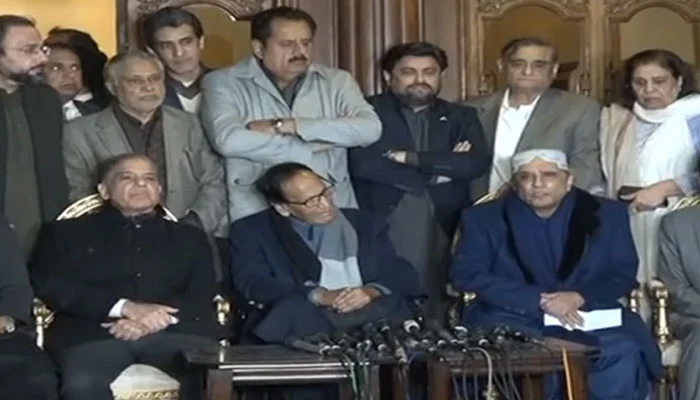
ISLAMABAD: With the ballots counted, the people of Pakistan have made their voices heard. If we use the popular vote as an indicator, PTI appears to be slightly less popular today than it was in 2018, while both PML-N and PPP have seen roughly a 10% increase in popularity since 2018.
This marks the twelfth election in the last half-century. Serious allegations of rigging persist, mirroring patterns seen in the previous eleven elections. Nothing new there. As in the case of the previous eleven elections, election tribunals will hear and resolve disputes related to the conduct of elections, including allegations of rigging. Nothing new there either. What Pakistan urgently requires is a stable government.
With political parties struggling to provide Pakistan with a stable, predictable government, the economy is the primary casualty. Yes, arriving at the precise cost of the current political uncertainty is difficult, it is evident that there are measurable impacts on the economy.
Here are three, direct, immediate economic losses: The Pakistan Stock Exchange (PSX) has lost around $2 billion. Pakistan’s international dollar bond has lost the most in seven months. And, this uncertainty will most definitely deter potential foreign investors, leading to missed opportunities for economic growth and job creation.
In addition to the direct and immediate economic losses, there will be at least three indirect economic impacts: One-heightened uncertainty will negatively impact consumer confidence, leading to decreased consumer spending, which will, in turn, affect various economic sectors, including retail. Two-businesses will postpone crucial investments due to uncertain future economic conditions, which is bound to depress overall growth. Three-delayed decision-making and disruptions in economic activity are bound to contribute to inflationary pressures.
Certainly, determining the precise cost of political uncertainty is a formidable task. However, leveraging various economic indicators and modeling tools can offer valuable insights and approximate estimates. My analysis suggests a prolonged government vacuum could hemorrhage anywhere between $15 billion and $30 billion. Understanding these potential losses highlights the importance of finding a swift and peaceful resolution to form a government and stabilize the political and economic landscape of Pakistan. The responsibility lies squarely on the people we have elected to govern and lead our nation.


