
Sindh govt plans to induct 180 electric buses for BRT feeder routes
The Sindh government has decided to induct 180 electric buses, to be powered by solar energy, on the feeder routes of the Bus Rapid Transit Service in Karachi so that cleaner and more efficient public transportation solutions could be provided, in addition to bringing an end to the system of an operational subsidy for public transport service.
This was disclosed in a meeting held between Sindh Caretaker Chief Minister Justice (retd) Maqbool Baqar and an Asian Development Bank (ADB) delegation led by F. Cleo Kawawaki, principal director and head of office of market development and PPPs.
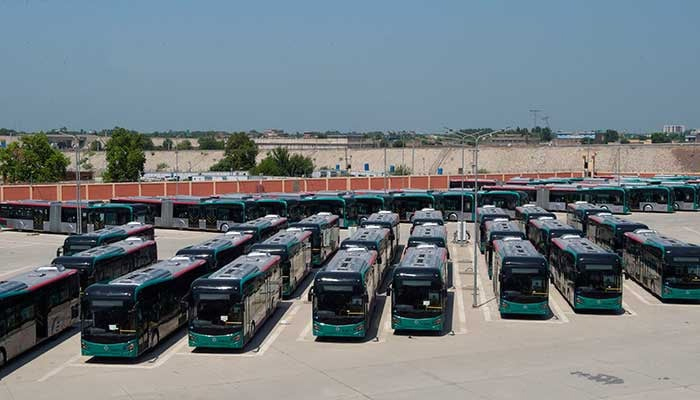
Discussing the option of launching electric buses for BRT feeder routes in the city, the CM said that the Sindh government was exploring the transformative impact of electric buses to strive for cleaner and more efficient public transportation solutions in Karachi. The project aims to introduce electric buses on BRT feeder routes.
It aligns with the provincial government’s focus on climate change, resilience, and carbon credits. The operational business plan of the project is going to commence at the end of December 2023.
Chairman Planning and Development Board Sindh Shakil Mangejo told the ADB head that the Green and Orange Lines of BRTS had been implemented in Karachi to facilitate an estimated passenger traffic of 50,000 per day.
With the induction of feeder route buses, existing and future lines will be integrated, which will contribute towards the long-term sustainability of the overall system. The transport secretary said that under the project 170 to 180 electric buses would be inducted for the existing BRT routes of Green and Orange Line.
ADB delegation head F. Cleo Kawawaki said that the ADB was working with the provincial government and would support the project. The CM, talking about the West Karachi Recycled Water Project, said that Karachi was one of the most water-stressed cities. The city has a population of more than 20 million and requires 1,100mgd of water supply but only receives 550mgd; therefore, more investment in the water supply and treatment infrastructure is badly needed.
The Karachi Water & Sewerage Corporation mandated the ADB to be the transaction adviser about an unsolicited proposal for a treatment plant at Haroonabad near Sindh Industrial Trade Estate (SITE). A market survey shows that the present water demand of industries at SITE is 40-50mgd. Due to water shortage, the KWSC is only able to supply around 2-3mgd.
MD Public Private Partnership Unit Asad Zaim said that the project would cost around $180 million and the prequalification process has been completed, and four bidders were competing in the RFP (request for proposal) stage. He added that the ADB expert team was working on the project documentation with the provincial government.


