
Poet Naina Adil’s debut novel is quite engaging, a serious achievement
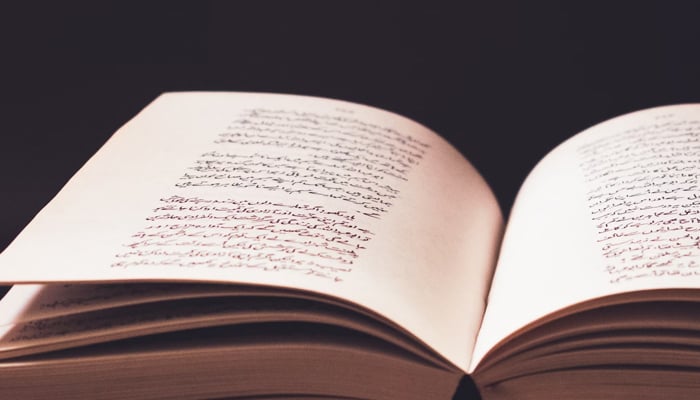
There are writers who circumambulate their novels, looking at the characters and events from different angles and vantage points -- a sort of clinical detachment which is often unconvincing.
At the other end of the spectrum are novelists who appear to be entangled with their characters, so much so that they fall in rapport with the persons and mise en scene they have created.
If the novels themselves are forceful enough, the difference hardly matters. Whether a gloved or masked approach or a symbiotic intimacy, the novels, even if ironical in intent, are always charged with direct or indirect sympathy.
Naina Adil, in her first novel ‘Muqaddas Gunah’ (holy sin), obviously belongs to the second category, constantly suffering and empathising with her characters. As her first foray in the field of fiction, her work is quite engaging, an achievement not to be sneezed at.
The locale is mostly Karachi, a mega metropolis riven by political, sectarian and ethnic violence: a vibrant place teetering on the brink of anarchy.
The novel can be termed a family saga, with some of its members possessing an artistic and humanitarian bent, in love with music, dance, painting and poetry, and altruistically interested in educating the young.
Here I will, in the context of the novel, dispense with Tolstoy’s famous dictum about happy and unhappy families, and conclude that essentially all families are unhappy.
Each family is a network, bringing together, for better or worse, lots of persons who have little in common, and perhaps find it demeaning to see eye to eye.
The novel covers generations, though not in detail, but the complexity and interplay of familial relationships make it difficult to come up with a neat summary.
The central character is Mahvesh, also known as Dia. Her mother committed suicide when Dia was only two months old, and her father found his in-laws averse to seeing him and vice versa. So Dia is literally an orphan, naive and vulnerable. Being a gifted painter does not make her worldly-wise.
An unscrupulous cousin, Nabeel, seduces her, has sex with her, takes photos of her in disarray. The intent is to blackmail her and her family, so that they, in order to avoid a scandal, will agree to let him have Dia as his wife.
It actually comes to nothing as Nabeel is shot dead soon afterwards, an occurrence so common in Karachi that it precludes any serious investigation.
Meanwhile, Wajahat, another cousin, but one she is in love with and wishes to marry, disenchanted by the scandal and the suspicion that he might be responsible for Nabeel’s murder, goes away to the US and becomes a skilled physician.
Dia is married off to a man she does not like and who simply cannot make any sense of her. Finally, Wajahat comes back, makes Dia’s husband divorce her.
Dia and Wajahat get married, a short period of bliss, then another murder takes place, again it is assumed that Wajahat might be implicated in it, so to avoid any further unpleasantness, he goes back to the US.
The axis of the novel, Dia, is a highly-strung, susceptible person, a talented painter and arachnophobic. The ambiguous wasteland within her unslaked being is rife with real or imaginary spiders, which seem to her like visitations from a privatised inferno.
That she holds on to her sanity, reveals her potential for survival. The novel which seems a flurry of disasters and disparagements ends on a note of hope, or perhaps a sense of ripening optimism. Naina Adil is also a poet, and may now be noted as a novelist of considerable promise.
There are streaks of rhetoric here and there in her prose, but within a novel so full of intensity and indignation, such wordslides are perhaps inevitable.
But what about the holy sin? Will mercy or forgiveness have any meaning if there was no sin? Human history began with Adam and Eve, who disobeyed God’s command and partook of the forbidden fruit. The punishment: exile from paradise and regency of the world. So be holy sinners, and seek forgiveness.
The writer is an Urdu poet, author and critic. His creative output includes books for children and translations of Western classics into Urdu.






-
 Chyler Leigh Pays Moving Homage To 'Grey’s Anatomy' Co-star Eric Dane: 'He Was Amazing'
 -
 Did You Know Tech CEOs Limit Screen Time For Their Own Kids?
 -
 Matthew Lillard Admits Fashion Trends Are Not His 'forte'
 -
 SpaceX Launches Another Batch Of Satellites From Cape Canaveral During Late-night Mission On Saturday
 -
 Princess Beatrice, Eugenie Get Pulled Into Parents’ Epstein Row: ‘At Least Stop Clinging!’
 -
 Inside Kim Kardashian's Brain Aneurysm Diagnosis
 -
 Farmers Turn Down Millions As AI Data Centres Target Rural Land
 -
 Trump Announces A Rise In Global Tariffs To 15% In Response To Court Ruling, As Trade Tensions Intensify
 -
 Chappell Roan Explains Fame's Effect On Mental Health: 'I Might Quit'
 -
 AI Processes Medical Data Faster Than Human Teams, Research Finds
 -
 Sarah Ferguson’s Friend Exposes How She’s Been Since Andrew Mountbatten-Windsor’s Release
 -
 Jelly Roll Explains Living With 'severe Depression'
 -
 Charli XCX Applauds Dave Grohl’s 'abstract' Spin On Viral ‘Apple’ Dance
 -
 Anna Sawai Opens Up On Portraying Yoko Ono In Beatles Film Series
 -
 Eric Dane's Wife Rebecca Gayheart Shares Family Memories Of Late Actor After ALS Death
 -
 Palace Wants To ‘draw A Line’ Under Andrew Issue: ‘Tried And Convicted’