
Hospital waste continues to wash ashore on Clifton beach
Hazardous medical waste, including used syringes and test tubes containing blood and other body secretions, continued to wash ashore on the Clifton beach on Wednesday.
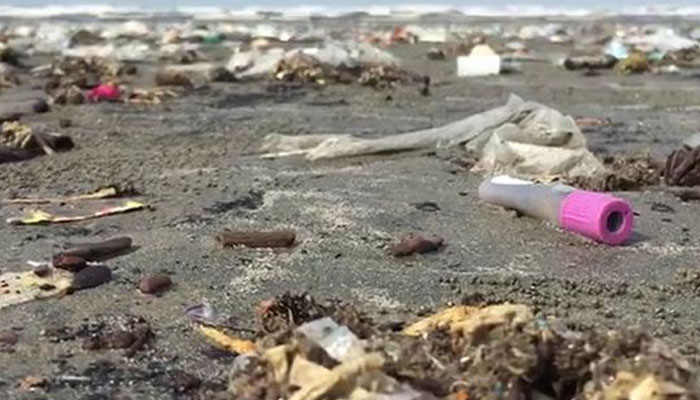
Hazardous medical waste, including used syringes and test tubes containing blood and other body secretions, continued to wash ashore on the Clifton beach on Wednesday.
When students from different educational institutions reached the beach during the day and tried to collect the hazardous waste, they were warned by medical experts and media persons against cleaning the resort without a proper safety gear.
Hundreds of syringes and other hospital waste were visible on the beach along the Seaview area even on Wednesday. The waste could not be removed by the authorities while some families and people were seen roaming the beach barefoot, and they were advised by social activists and media persons to either wear shoes before coming to the beach or keep away as the place was strewn with hazardous hospital waste.
Also read: Authorities spring to action at Clifton beach after Shaniera Akram's tweet
The issue was brought to the notice of common people and the authorities by Shaniera Akram, wife of former cricket star Wasim Akram, who posted videos and pictures of the syringes and other hospital waste littering the beach on Tuesday morning, compelling Sindh Chief Minister Syed Murad Ali Shah and the environment adviser to take notice of the situation.
The Cantonment Board Clifton and Defence Housing Authority also carried out a beach-cleaning exercise on the same day, but the situation remained that same. When students from different schools and colleges were brought to the beach by some NGOs for cleaning the place, they found more syringes and hospital waste there, from a shopping mall to the other stretch of the beach, while picnickers were seen visiting the beach without knowing about the presence of open needles and syringes in the sand.
“Today, we were asked to carry out a beach- cleaning exercise and provided plastic gloves, but when we reached Clifton, we found more syringes and tubes. When we tried to pick them up, we were asked by some people, including media persons, not to do that as it could be dangerous for us too,” Ayaz Ahmed, a student of 9th class, said while talking to journalists.
Visitors were astonished to learn that there was Section 144 imposed to prevent people from visiting the beach while many also expressed ignorance of the presence of open needles and used syringes on the beach, saying no warning signs or people were present there to guide them in this regard.
Meanwhile, Shaniera Akram continued her tweets about the hospital waste littering the beach and said: “CBC should not be handling this clean up alone. There is dangerous medical waste that is coming in from the city and there needs to be a thorough investigation in to how this medical waste is ending up on our beach.”
“Now is the time to act, come together & use what has happened as a wake up call.80% clean is not good enough for me & certainly not good enough for the people of this city. This problem can’t just go away from cleaning the beach we need to go straight to the source of the problem,” she said in another tweet.
Shaniera also tweeted that provincial environment adviser Murtaza should call her directly “if he really thinks my tweet was negative and there was only a handful of syringes. This is not a time we should be shifting blame, this is a time we need to all come together to do what is right for our city and it’s people”.
Carcasses on roads
On the other hand, dozens of carcasses of dead buffaloes, cows and goats were found lying on roads in Bhains Colony and the unbearable stink emitting from them had created another environmental hazard for the people of the area.
Video clips and pictures of dead animals were posted on social media platforms, with showed that these animals had died during the recent rains and the resulting unhealthy conditions, and the animals were thrown in open places and along roads, instead of properly disposing them of.
An official of the Sindh Environmental Protection Agency said they had learnt about the presence of carcasses of dead animals in the cattle colony, and had requested the district administration of Malir to dispose them of properly.


