
‘Pakistan’s position on IWT needs to be based on international principles’
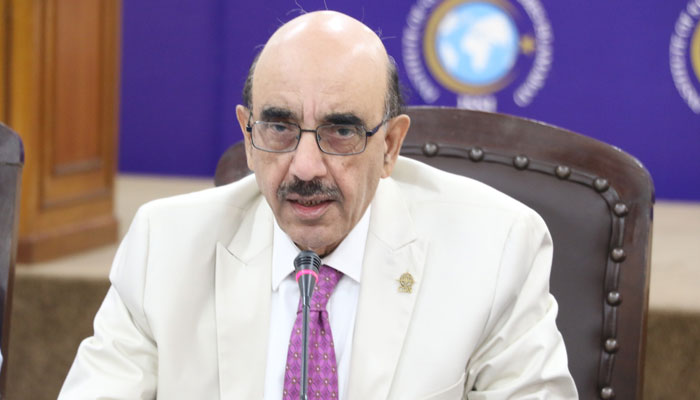
Islamabad:Sardar Masood Khan, President, Centre for Law and Security (CLAS) underlined that India carefully timed its actions, building a cascade of dams that give it strategic advantage, so Pakistan’s legal position needs to be firmly grounded in international principles.
Mr Masood was speaking at a seminar on “Weaponising water: the Indus Waters Treaty and future of regional stability” jointly organised here by Institute of Strategic Studies Islamabad (ISSI) and Centre for Law and Security (CLAS).
Mr Masood pointed out potential obstacles in bringing India to arbitration, including provisions in the Vienna Convention and India’s ability to avoid ICJ jurisdiction on issues related to Commonwealth nations. He recommended Pakistan to apply pressure through the World Bank, UN Security Council and key powers like the P5. He called for an assertive international campaign, while also urging Pakistan to maximise domestic water efficiency. Ultimately, Pakistan must choose between maintaining the status quo or pursuing a high-risk, proactive approach to safeguard its water future.
Shafqat Kakakhel, Chairperson, BoG, SDPI, highlighted the crucial link between Kashmir and water, emphasising that Pakistan’s rivers flow through the disputed region. He reminded that Indus Water Treaty (IWT) was not a water-sharing agreement but a river division arrangement heavily influenced by Indian demands. India, he claimed, enjoys uncontested control over the eastern rivers, while seeking to maximise its use of the western ones while ignoring Treaty constraints.
He dismissed the claim that Pakistan opposes all Indian projects and pointed to India’s non-compliance with the Court of Arbitration’s decisions. He recommended activating Article IX of the Treaty to initiate formal dispute resolution and appropriately raising the issue in the UN Security Council. He emphasised preserving the IWT as a legal shield for Pakistan’s water security and promoting sustained international diplomacy.







-
 AI Revolution Will Create More Jobs, Not Replace Them, Says Nvidia CEO
 -
 Princess Beatrice, Eugenie Resort To Begging King Charles: ‘We Won't Go Quietly!’
 -
 Australian Scientists Develop World’s First Quantum Battery In Major Energy Storage Breakthrough
 -
 Elon Musk Says Winning Oscar Becomes 'embarrassment' As Audience Drops
 -
 Argentina Exits World Health Organization Following US Lead: What It Means For Public Health And Diplomacy?
 -
 How Keith Urban Is Holding Up With Nicole Kidman's Rumoured 'romance' With Costar Simon Baker
 -
 ‘Emotionally Loaded’ Prince Harry Exposes Himself And Meghan Markle With ONE Mistake
 -
 Robert Pattinson Teases ‘extraordinary’ Storyline For ‘The Batman: Part II’
 -
 Gamers Reacts To NVIDIA DLSS 5, Label It AI Slop
 -
 Zendaya Reveals Inside Details Of Filming 'Euphoria 3'
 -
 'Nickelodeon' Actor Chris O’Neal Arrested In Malibu
 -
 Can You Trust AI With Science? Study Finds ChatGPT Often Gets Facts Wrong
 -
 Nvidia DLSS 5 Games List: Every Confirmed Title We Know So Far
 -
 Prince William Gets Forced Into A Tough Spot: ‘Its Outrageous Cut Them Loose!’
 -
 Adam Melchor Gets Roasted Recalling Childhood Bond With Michael B. Jordan: 'So Brave Adam Continue Sharing Your Truth'
 -
 Mysterious AI Model Sparks DeepSeek V4 Speculation