
JI city chief challenges ‘unjust’ multi-year tariff for K-Electric
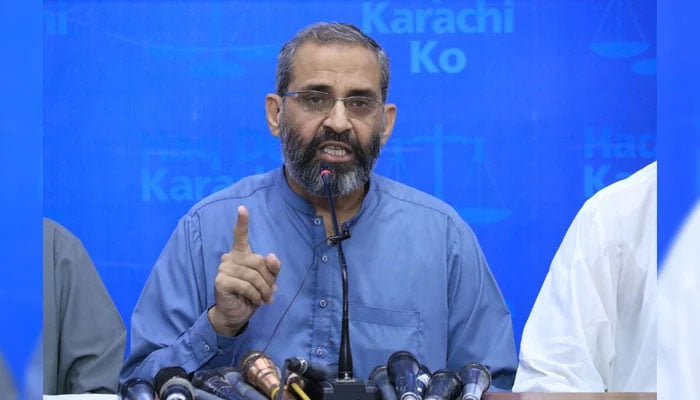
Jamaat-e-Islami Karachi Emir Monem Zafar Khan has challenged the multi-year tariff (MYT) granted to K-Electric by the National Electric Power Regulatory Authority (Nepra), describing the seven-year tariff as “the most expensive and anti-consumer decision in recent history”.
Khan has filed a review petition under Nepra Review Regulations, 2009, saying that the controversial tariff is “illegal, non-transparent and contrary to public interest”. On May 23 Nepra had approved KE’s transmission & distribution MYT for the period from 2023-24 to 2029-30. JI accused Nepra of granting KE unjustified financial concessions, similar to those given to independent power producers (IPPs), despite KE not being classified as one.
Khan’s petition highlighted that KE has been unjustly allowed dollar-indexed return on equity (RoE), even though the company is not covered under the 2002 power policy or any IPP framework, and KE’s original agreements from 2005 and 2009 do not entitle it to such benefits.
“It’s not just a matter of tariff; it’s a matter of injustice to millions. Karachiites are being punished for KE’s inefficiency, theft and profiteering. The burden of KE’s losses, inflated costs, and poor performance has been placed entirely on bill-paying consumers.”
He claimed that KE presented exaggerated investment projections and inflated costs, which were approved by Nepra without proper scrutiny. These include assumptions of over Rs400 billion in capital expenditures, high depreciation charges, interest costs, and RoE in foreign currency — all of which disproportionately benefit KE at the cost of consumers, he pointed out.
He also objected to Nepra allowing KE to claim losses based on a 92.76 per cent recovery rate, while the company had already achieved a 96.7 per cent recovery in 2022. “This gives KE the perverse incentive to underperform, and still recover losses from consumers. No such benefit is given to other distribution companies, particularly in Punjab.”
The review motion argues that this amounts to rewarding inefficiency, and allowing cross-subsidisation by honest consumers in paying arrears for the non-paying or theft-prone localities. Khan also expressed concern over the lack of any meaningful penalties for electricity theft. “KE’s business model is now based on unchecked profiteering: no accountability, no performance, only profits.”
He pointed out that the expensive power being delivered by KE has crippled residential, industrial and commercial consumers across the city. He demanded that Nepra immediately withdraw the unjust benefits given to KE, and issue a revised, transparent and lawful tariff structure that aligns with sections 31 and 32 of the Nepra Act. “This is not just about numbers; it’s about justice for Karachi. Consumers deserve protection, not punishment.”






-
 Nick Jonas Gets Candid About His Type 1 Diabetes Diagnosis
 -
 King Charles Sees Environmental Documentary As Defining Project Of His Reign
 -
 James Van Der Beek Asked Fans To Pay Attention To THIS Symptom Before His Death
 -
 Portugal Joins European Wave Of Social Media Bans For Under-16s
 -
 Margaret Qualley Recalls Early Days Of Acting Career: 'I Was Scared'
 -
 Sir Jackie Stewart’s Son Advocates For Dementia Patients
 -
 Google Docs Rolls Out Gemini Powered Audio Summaries
 -
 Breaking: 2 Dead Several Injured In South Carolina State University Shooting
 -
 China Debuts World’s First AI-powered Earth Observation Satellite For Smart Cities
 -
 Royal Family Desperate To Push Andrew As Far Away As Possible: Expert
 -
 Cruz Beckham Releases New Romantic Track 'For Your Love'
 -
 5 Celebrities You Didn't Know Have Experienced Depression
 -
 Trump Considers Scaling Back Trade Levies On Steel, Aluminium In Response To Rising Costs
 -
 Claude AI Shutdown Simulation Sparks Fresh AI Safety Concerns
 -
 King Charles Vows Not To Let Andrew Scandal Overshadow His Special Project
 -
 Spotify Says Its Best Engineers No Longer Write Code As AI Takes Over