
Adeela Suleman’s tapestry unravels East India Company’s exploitations
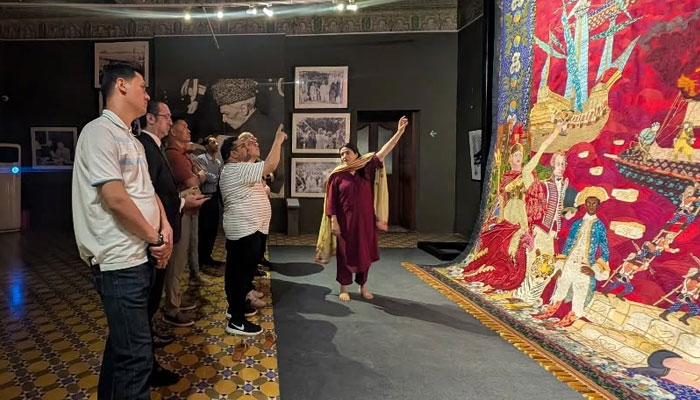
The Mohatta Palace Museum on Thursday evening hosted a special preview of a textile art exhibition titled ‘Imperium Amidst Opium Blossoms: A Kashidakari on the era of the East India Company’ by acclaimed artist Adeela Suleman.
The event, which was organised in collaboration with the Glynn Vivian Art Gallery in Swansea, offered visitors a first look at Suleman’s tapestry that reimagines colonial violence through intricate needlework rooted in the South Asian tradition of Kashidakari.
Nasreen Askari, founder-director of the Mohatta Palace Museum, said Adeela's work was based on the British East India Company and its dominion from 1757 to 1858 in India. “The word 'Imperium' implies supreme or absolute power which is exactly what the East India Company was about,” she explained.
Askari noted that the tapestry’s iconography and images signify defiance, resistance and terror. Amongst its many motifs, she went on, the viewers could see a resplendent Robert Clive, Britannia with her trident and her trophy, the red dragon of Wales, fleets of Chinese junks laden with opium sailing along the blood-stained depiction of the Pearl River. Intoxicated Chinese figures dressed in finery appears in the foreground, alongside a page boy of African descent. In the background, the British warship Nemesis looms while British soldiers are depicted frantically climbing up gangplanks.
"The highlights of the tapestry are the beautifully rendered white poppies that occupy and line the borders of this amazing piece," she added. Speaking about the artist, Askari said Suleman described herself as a warrior artist because themes of terror and violence tended to underpin a lot of her work.
Suleman said she was interested in the stories unfolding within the city. “I lived in Nazimabad and witnessed how the political situation was changing while we were studying there,” she said.
“We saw the clashes between political parties in areas like Kati Pahari and Lasbela". She added that Karachi University was another place where she learned about the city and what youth went through in the metropolis, including dynamics of the city.
“I was researching the city, violence and the region—looking into what was happening across the Muslim world. There are so many things that you cannot ignore when you study about the region, including the East India Company.”
She explained that her tapestry was just a book cover because "there were so many stories that she could not even touch upon, there were so many characters that are missing from the story."
Hameed Haroon shed light on the historical context depicted in the tapestry, explaining that Europeans, particularly the British, were desperate to import silk, porcelain and other things from China. The company used a malevolent system of cultivating opium in the Indian regions of Patna and Bihar and shipping it from Calcutta to Pearl River estuary, he added.
This was a form of gunboat diplomacy: the British used military force to impose the opium trade on China, creating widespread addiction while extracting silver in return. "They would go back first to Calcutta and then they would move on along the African coast, the Suez wasn't quite open at that time and then go back picking up slaves from West Africa from the Gold Coast and taking them to Europe where subsequently not too long after slavery began to be banned.”
Commenting on Suleman’s tapestry, Haroon remarked: “What she’s doing here is powerful. She is showing us layers of imperialism, violence, and resistance.” Haroon said that this tapestry, created with the help of a team of 30 artisans from two workshops, took over two-and-a-half years to complete.







-
 Hilary Duff Opens Up About Marriage Fears Despite Strong Bond With Matthew Koma
 -
 ‘Grey’s Anatomy’ Star Eric Dane Breathes His Last At 53
 -
 Donald Trump Breaks Silence On Andrew’s Arrest: ‘It’s A Shame’
 -
 DJ Khaled Shares Weight Loss Progress
 -
 Jennifer Aniston And Jim Curtis Share How They Handle Relationship Conflicts
 -
 Shamed Andrew Real Birthday Plans As Cops Showed Up At Door
 -
 Pete Davidson’s Girlfriend Elsie Hewitt Says 'everything Hurts' After Sudden Medical Emergency
 -
 Princess Beatrice 17 Holidays Per Year Exposed Amid Andrew Arrest
 -
 Who Is 'Queen Of Woke'? UK First Female Civil Head
 -
 Dwayne Johnson Confesses What Secretly Scares Him More Than Fame
 -
 Elizabeth Hurley's Son Damian Breaks Silence On Mom’s Romance With Billy Ray Cyrus
 -
 Shamed Andrew Should Be Happy ‘he Is Only In For Sharing Information’
 -
 Daniel Radcliffe Wants Son To See Him As Just Dad, Not Harry Potter
 -
 Apple Sued Over 'child Sexual Abuse' Material Stored Or Shared On ICloud
 -
 Nancy Guthrie Kidnapped With 'blessings' Of Drug Cartels
 -
 Hailey Bieber Reveals Justin Bieber's Hit Song Baby Jack Is Already Singing