
Shying from the truth
Editing the truth is a habit we adopted very early on as an independent country
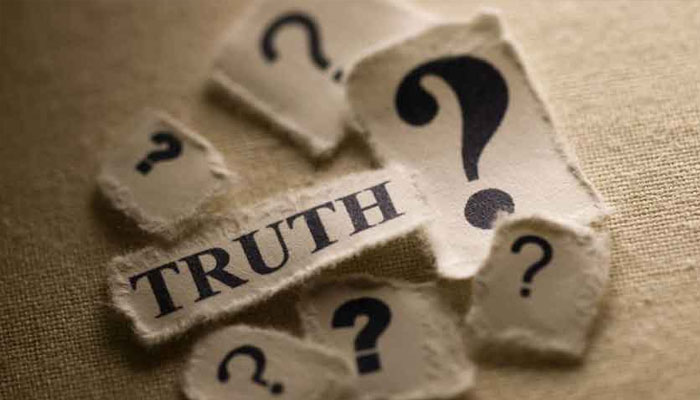
The history of successive generations of the ruling elite remaining shy of letting the truth be known about their days in power and how they dealt with the challenges they faced is long and painful. And there is ample reason why it is so.
Editing the truth is a habit we adopted very early on as an independent country, and it remains a trait we have steadfastly persisted with. In the process, no one has escaped the pain of the scissors ramming through reams of fact sheets dealing with various phases bearing monumental importance for the fate of the country.
Even the Quaid’s speech which he delivered from the floor of the constituent assembly on August 11, 1947, was not spared. The speech had outlined in detail the foundational ethos of what kind of country he envisioned Pakistan to become. Since it did not go down well with the perception of some, the speech had little impact in framing the conduct of the state and its leaders after his death. In the days of General Ziaul Haq, it even disappeared from the archives only to resurface at some later stage. Then and now, the contents of the speech hardly reflect what the country has come to espouse as its ideology.
History tells us that an unannounced embargo was also placed on Fatima Jinnah’s speeches. Once, when she was finally allowed to speak, her words went off air after the first couple of minutes because she opted for strumming some unpleasant truth. Later, when she fought the elections to be the president of the country, she was dubbed a traitor and hounded.
The Hamoodur Rehman Commission Report on the facts pertaining to the war in 1971 was never formally validated by the state. After the report was unveiled by the commission, which had been set up by the government of the time, the state could have accepted or rejected its findings. In case of the latter, it could have come out with its own version of what transpired during those eventful days because, after all, people have a right to know. But it did neither of the two, thus rendering the report controversial. In current times, even a mention of its contents elicits accusations of treachery.
The facts behind the murder of a sitting and a former prime minister have been kept from the public space, while it is only recently that the hanging of a former prime minister has been dealt with by the Supreme Court of the country, 45 years after the occurrence. In its judgement, the Supreme Court opined that “the proceedings of the trial by the Lahore High Court and of the appeal by the Supreme Court of Pakistan do not meet the requirements of the fundamental rights to a fair trial and due process as enshrined in article 4 and 9 of the constitution and later guaranteed as a separate and fundamental right under Article 10A of the constitution”.
While gross corruption and misdeeds of numerous varieties have escaped accountability because of the ruling elite's unremitting patronage, even the works of writers and intellectuals have not been spared the sordid treatment of scissors. In fact, many such works have remained banned for prolonged periods of time.
As part of researching the works of Faiz Ahmad Faiz, I discovered that sections of two of his most notable poems were missing or, more correctly, were not included in the published works of the poet. These are from his poems titled ‘Wayabqa Wajahu Rabeka’ and ‘Nida-e-Ghaib’. While just a few lines are missing from the former, two complete stanzas have been eliminated from the latter poem. I have spoken to some of my friends who share our love for Faiz, and who have read and taught him extensively, but could not discover any credible reasons for the same except that, at some stage, these omissions may have become compulsions of the times.
The fact that many of the rebel poets and writers had to suffer incarcerations over prolonged periods of time, while Faiz also had to endure the pain of self-imposed exile, speaks volumes about the level of intolerance that has crept within the ruling and societal folds. Faiz bemoaned in one of his classics:
“O’ my heart, my companion,/The potentate has ordained again/That we should be exiled from the city/To go calling from street to street,/And wandering from land to land,/That we could find a clue/Of a friend who would carry a message.”
We insist on measuring truth by our flawed and often prejudiced benchmarks. We are starkly unwilling to accept anything that lies beyond the myopic parameters we have developed for testing others’ loyalty and patriotism. So, we suffer going round in circles, which project no avenues to walk out and forward. Thus, we live the perennial labour of solidifying a structure that, denied the space needed to breathe, grows likelier to crumble with time. Yet we remain adamant in our mendacity and driven by our laboriously cultivated mediocrity.
We manipulate the system to suit the exclusive needs of those anointed in positions of power. Agenda-fixated legislation like the 26th Amendment is adopted to dismantle the edifice of the judiciary and render it subservient to the executive. Dishonesty and unsuitability for a position are the yardsticks by which people are nominated for top organisational offices.
We bask in the pain of the marginalised communities who survive on the fringes of life for two measly meals a day. The pelf and power of the beneficiary elite keep piling as do the existential risks faced by the downtrodden and the underprivileged. As disparities increase, people are forced to leave the country for their survival.
The HRCP Annual Report released recently has highlighted the “troubling decline in civic freedoms, deteriorating law and order, and a marked strain on federalism” as issues to be concerned about. It also speaks of the February 2024 elections as “compromised by allegations of electoral manipulation”. These are the factors that inflict pain upon people who are joined together in love of their country.
Truth can be bitter. It often is, but it also gives us the space to learn from, make amends for mistakes committed and ensure that these are not repeated. Shunning it or pruning it to suit person- and time-specific needs will only complicate matters and push us further back into the dungeons of regression.
More freedom, not less, and more rights, not less, would break us free of the stranglehold we have been caught up in for long. Anything failing that would not suffice to leave this mounting pile of morass behind and walk into better climes.
The writer is a political and security strategist and the founder of the Regional Peace Institute. He is a former special assistant to former PM Imran Khan and heads the PTI’s policy think-tank. He tweets @RaoofHasan






-
 Russell Brand’s Rape Trial Date Changes And Moves Up Months: Report
 -
 Is Using AI For Therapy Safe? Study Raises Concerns
 -
 After Earning £2-3 Million Sarah Ferguson Gets Exposed: ‘Will She Go Forward With A Memoir?’
 -
 King Charles Sends Meaningful Message To Prince Harry After Duke's Olive Branch
 -
 'Legally Blonde The Musical' Star Amber Davies Makes Raw Confession After Burnout
 -
 Superbugs On Rise As Climate Change Drives Antibiotic Resistance, Study Finds
 -
 Microsoft AI CEO Says AI Chip Shortage Will Decide Tech Winners In 2026
 -
 Tiger Woods' Net Worth Explained Amid His Shocking DUI Arrest
 -
 BTS Launch ‘BTS 2.0’ Era With Explosive ARIRANG Comeback
 -
 Taylor Swift's Fiancé Travis Kelce Labelled 'dumb, Fugly, Chubby'
 -
 Sarah Ferguson Changes Strategy As She Plans 'dramatic Reinvention'
 -
 Inside Britney Spears’ Yacht Trip After Going Private On Instagram
 -
 Mistral Raises $830M For Nvidia-backed Data Centers, Advancing Europe’s AI Sovereignty
 -
 WhatsApp Beta Brings Full Messaging To CarPlay Interface
 -
 Who Is Royal Family's 'next Superstar' And Genuine Asset To Crown?
 -
 West Coast House Pioneer DJ Dan Breathes His Last At 57