
Extremism in Sindh not homegrown but brought from elsewhere, CM tells British diplomat
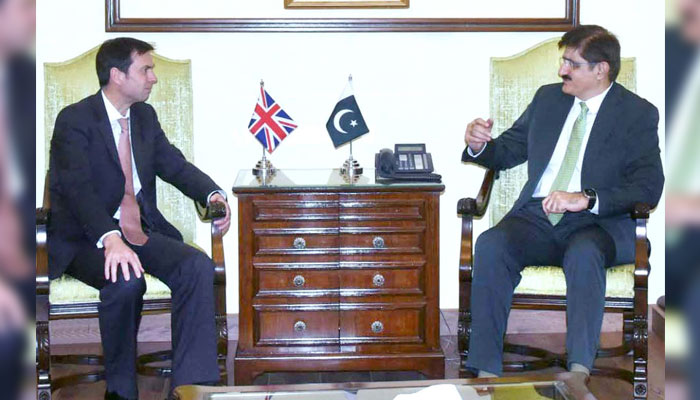
Sindh remains a province free from extremism. Whatever extremism that has taken place in the province is not home-grown but involves external sources.
Sindh Chief Minister Syed Murad Ali Shah said this while talking to the newly appointed British deputy high commissioner, Lance Domm, who called on him at the CM House on Wednesday. “We take pride in being a province that is free from extremism,” Shah said, adding that terrorism was not homegrown in Sindh but had infiltrated from external sources.
Discussing Sindh's progressive and inclusive society, he reiterated the provincial government's commitment to protecting minority rights. “Sindh is an inclusive society, and minorities here enjoy equal rights,” he maintained.
During the meeting, the CM and the visiting diplomat discussed Pakistan-UK relations, post-flood rehabilitation, and various socio-economic challenges facing the province. The CM welcomed the new deputy high commissioner and highlighted the longstanding and strong relations between Pakistan and the United Kingdom. He assured the visiting diplomat of full cooperation from his government in fostering mutual collaboration.
In response, Domm expressed gratitude for the warm reception and support extended by the Sindh government. During the meeting, discussions focused on the rehabilitation efforts following the devastating 2022 floods. Shah said the primary challenge was restoring the agricultural sector. “We restored agricultural land and provided seeds and fertilisers, resulting in a bumper wheat crop,” he noted.
He further said that with assistance from the international community and World Bank, the construction of homes for flood victims had been progressing rapidly. Talking about climate change, he emphasised that Sindh and its people had been among the hardest hit by shifting weather patterns.
The CM also spoke about the economic challenges in the agriculture sector, noting that the provincial government had increased the agricultural tax from 35 per cent to 45 per cent. He pointed out that due to water shortage, high fertiliser cost and rising input prices, farming was no longer a highly profitable profession.







-
 Milo Ventimiglia Calls Fatherhood 'pretty Wild Experience' As He Expects Second Baby With Wife Jarah Mariano
 -
 Chinese Scientists Unveil Advanced AI Model To Support Deep-space Exploration
 -
 Anthropic’s New AI Tool Wipes Billions Off Cybersecurity Stocks
 -
 Trump Announces He Is Sending A Hospital Ship To Greenland Amid Rising Diplomatic Tensions
 -
 'Never Have I Ever' Star Maitreyi Ramakrishnan Lifts The Lid On How She Avoids Drama At Coffee Shops Due To Her Name
 -
 Inside Prince William’s Plans For Prince Harry: What Will Happen To Duke Once He’s King
 -
 Chyler Leigh Pays Moving Homage To 'Grey’s Anatomy' Co-star Eric Dane: 'He Was Amazing'
 -
 Did You Know Tech CEOs Limit Screen Time For Their Own Kids?
 -
 Matthew Lillard Admits Fashion Trends Are Not His 'forte'
 -
 SpaceX Launches Another Batch Of Satellites From Cape Canaveral During Late-night Mission On Saturday
 -
 Princess Beatrice, Eugenie Get Pulled Into Parents’ Epstein Row: ‘At Least Stop Clinging!’
 -
 Inside Kim Kardashian's Brain Aneurysm Diagnosis
 -
 Farmers Turn Down Millions As AI Data Centres Target Rural Land
 -
 Trump Announces A Rise In Global Tariffs To 15% In Response To Court Ruling, As Trade Tensions Intensify
 -
 Chappell Roan Explains Fame's Effect On Mental Health: 'I Might Quit'
 -
 AI Processes Medical Data Faster Than Human Teams, Research Finds