
‘Pakistan’s blue economy holds transformative potential’
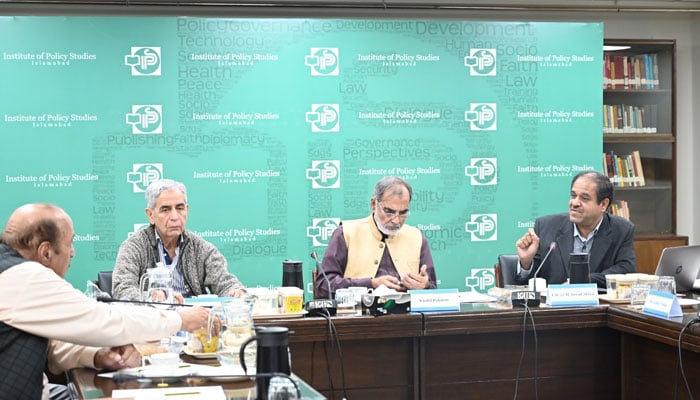
Islamabad:Pakistan’s blue economy holds transformative potential as a strategic economic driver. However, unlocking it hinges on key enablers, i.e., political backing, policy continuity, and institutional coordination, along with overcoming bureaucratic inertia, policy stagnation, and infrastructure gaps. This needs a proactive approach focused on strengthening governance and fostering synergies.
This was observed by experts during a roundtable discussion titled “Navigating Pakistan’s Blue Economy: Strategic Insights and Future Roadmap,” held at the Institute of Policy Studies Islamabad. IPS Khalid Rahman reiterated that Pakistan’s blue economy remains underutilized due to governance failures that extend beyond a single sector. As such, there must be a deliberate effort to link policy with action across multiple domains to realize its full potential.
He also said national consciousness on maritime affairs must be cultivated, particularly among youth who actively engage with digital platforms. Former SAPM maritime affairs Vice Admiral (r) Iftikhar Ahmed Rao, who was the guest of honour, briefed participants on the National Maritime Policy (NMP) 2025, highlighting recently endorsed structural, operational, and strategic reforms proposed by the Task Force on Revamping Pakistan’s Maritime Sector.
He said Pakistan’s maritime future hinges on the effective implementation of the reforms and welcomed the growing awareness of maritime and blue economy discourse, stressing its importance for national economic resilience. Cdre (r) Muhammad Jawad Akhtar, former advisor maritime affairs, Planning Commission, said to drive maritime transformation, the targets must include enhancing the capacity of the Ministry of Maritime Affairs and FBR, aligning policies with actionable directives, increasing transit trade and transshipment volumes, third-party audits, and reviving Pasni Harbor.
He, however, warned that delays in approvals, technological and infrastructure gaps, resistance to privatization, capacity constraints, geopolitical trade barriers, and sustainability concerns remain major hurdles. He said the task force should engage with international port operators for knowledge transfer and technological integration, collaborate with labor unions to ensure fair labor practices in privatization, and strengthen the maritime linkages within URAAN Pakistan.
These are essential practices for sustaining long-term growth and competitiveness in the sector, according to him. Cdre (r) Muhammad Obaidullah, maritime and defense analyst, criticised the imposition of a 33% tax on the maritime sector in 2023, arguing that it reduces Pakistan’s competitiveness in the global market, especially when tax-free incentives were in place in the 2001 policy.






-
 Hilary Duff Opens Up About Marriage Fears Despite Strong Bond With Matthew Koma
 -
 ‘Grey’s Anatomy’ Star Eric Dane Breathes His Last At 53
 -
 Donald Trump Breaks Silence On Andrew’s Arrest: ‘It’s A Shame’
 -
 DJ Khaled Shares Weight Loss Progress
 -
 Jennifer Aniston And Jim Curtis Share How They Handle Relationship Conflicts
 -
 Shamed Andrew Real Birthday Plans As Cops Showed Up At Door
 -
 Pete Davidson’s Girlfriend Elsie Hewitt Says 'everything Hurts' After Sudden Medical Emergency
 -
 Princess Beatrice 17 Holidays Per Year Exposed Amid Andrew Arrest
 -
 Who Is 'Queen Of Woke'? UK First Female Civil Head
 -
 Dwayne Johnson Confesses What Secretly Scares Him More Than Fame
 -
 Elizabeth Hurley's Son Damian Breaks Silence On Mom’s Romance With Billy Ray Cyrus
 -
 Shamed Andrew Should Be Happy ‘he Is Only In For Sharing Information’
 -
 Daniel Radcliffe Wants Son To See Him As Just Dad, Not Harry Potter
 -
 Apple Sued Over 'child Sexual Abuse' Material Stored Or Shared On ICloud
 -
 Nancy Guthrie Kidnapped With 'blessings' Of Drug Cartels
 -
 Hailey Bieber Reveals Justin Bieber's Hit Song Baby Jack Is Already Singing