
Caretaker govt highlights fiscal performance as term ends
The finance ministry has painted a rosy picture of the economy
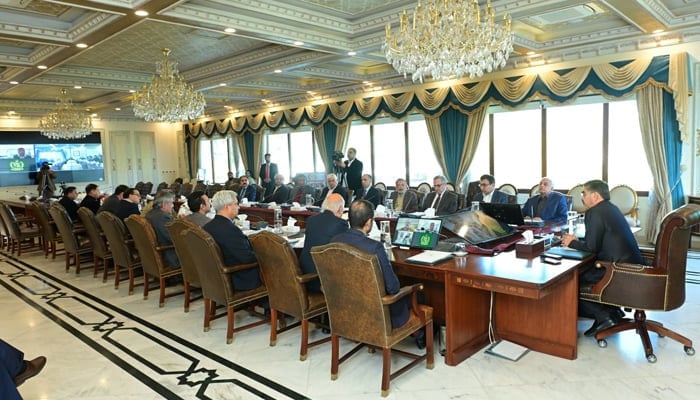
ISLAMABAD: At the twilight of the tenure of caretaker government, the finance ministry has painted a rosy picture of the economy.
In its monthly economic outlook released on Thursday, the ministry said that difficult and unpopular measures, including a reduction in the subsidy bill on power and gas through timely implementation of quarterly tariffs, helped improve the primary account. No supplementary grants had been issued during this period and the PSDP projects that fall under the provincial domain had been transferred to provincial ADPs, added the report. “At the same time, we have increased the release of funds for 9.3 million most vulnerable households,” the report said.
It claimed that the new government would help revive the economy and build on the hard-earned gains made over the last six months. “As the new government takes office after the general election, expectations are that a vibrant strategy and vision would help revive the economy and build on the hard-earned gains made over the last six months. The last few months’ measures have restored market confidence and led to a pick-up in economic activity,” the ministry said.
Instead of making a comparative analysis of the tenure of two governments before or after the installation of the caretaker government, the report states that the SBP FX reserves were raised to $8.1 billion, compared to $4.4bn in June 2023, while reducing the swaps from commercial banks to $3.5 billion, from $4.5 bn in June 2023. Everyone knew that the foreign exchange reserves of the SBP were raised in July and August 2023 before leaving the office by the PDM-led regime through Saudi Arabia’s deposits of $2 billion and IMF tranche of $1.1 billion as well as other inflows, but the report compared the Foreign Exchange Reserves (FER) held by the SBP from June 2023.
The report states that higher markup payments are putting significant pressure on expenditures. However, the government’s persistent efforts to curtail non-markup expenditures through austerity measures facilitated a continuous improvement in primary surplus. It is, therefore, expected that the continuity of fiscal consolidation efforts would support maintaining the fiscal deficit within manageable limits, added the report. “The inflation outlook for the upcoming month points towards a downward trajectory owing to better crops and a smooth supply of commodities,” it claimed.
Similarly, favourable input situations are set to bolster Rabi crop production. On the other hand, industrial activity in December remained positive despite a specific sectoral slowdown. Notwithstanding, restrictive monetary and fiscal policies, the optimism is fuelled by improvements in cyclical conditions in Pakistan’s export markets facilitating steady economic recovery.
The stabilisation measures encouraging business confidence, coupled with exchange rate stability, would contribute to a positive economic outlook for Pakistan amidst ongoing challenges, it added.
Data from Q2 FY2024 is showing stronger performance of the manufacturing sector, with large-scale manufacturing posting an 8.2pc increase over Q1. “We expect Q2 FY2024 GDP growth to rise to around 3pc on stronger manufacturing output and higher production of crops including cotton, which has increased by 75pc to 8.35 million bales,” the report said. To tackle these challenges, the caretaker government took steps to reduce unproductive expenditures and boost tax and non-tax income. During Jul-Dec FY2024, the government ran a primary surplus of Rs1.5 trillion (1.4pc of GDP) against the IMF SBA target of 0.5pc of GDP.
The improvement in the fiscal position has helped the government reduce the accumulation of public debt. Net domestic borrowing has decreased by 67pc to Rs1.9 trillion, from Rs5.8 trillion in the preceding period. The lower domestic borrowing, lower cost of borrowing on margin (below the SBP policy rate) and extended maturity profile helped lower net domestic borrowing. Most of all domestic debt profile has improved to 3.1 years in Jan 2024 from 2.7 months in Jun 2023.
The government also successfully launched a one-year Sukuk on the PSX, the first auction was held in November 2023, raising lower-cost debt from non-bank and retail investors. Similarly, external net borrowing meanwhile fell to $0.3 billion, compared to $3bn in the preceding period.
At the heart of the economic challenges facing Pakistan today is the unsustainable public debt position, with Pakistan in breach of the Fiscal Responsibility & Debt Limitation Act since 2013. The government’s ability to service the public debt liabilities is hampered by weak tax collection, rising losses of SOEs and the highest interest rates since 1972.







-
 Why Prince William Releases Statement On Epstein Scandal Amid Most 'challenging' Diplomatic Trip?
 -
 Historic Mental Health Facility Closes Its Doors
 -
 Top 5 Easy Hair Fall Remedies For The Winter
 -
 Japan Elections: Stock Surges Record High As PM Sanae Takaichi Secures Historic Victory
 -
 Prince William, Kate Middleton Finally Address Epstein Scandal For First Time: 'Deeply Concerned'
 -
 Kim Kardashian Promised THIS To Lewis Hamilton At The 2026 Super Bowl?
 -
 Andrew Mountbatten-Windsor Throws King Charles A Diplomatic Crisis
 -
 Barack Obama Hails Seahawks Super Bowl Win, Calls Defense ‘special’
 -
 Pregnant Women With Depression Likely To Have Kids With Autism
 -
 $44B Sent By Mistake: South Korea Demands Tougher Crypto Regulations
 -
 Lady Gaga Makes Surprising Cameo During Bad Bunny's Super Bowl Performance
 -
 Paul Brothers Clash Over Bad Bunny's Super Bowl Performance
 -
 South Korea: Two Killed As Military Helicopter Crashes During Training
 -
 Elon Musk Unveils SpaceX’s Moon-first Strategy With ‘self Growing Lunar City’
 -
 Donald Trump Slams Bad Bunny's Super Bowl Performance: 'Absolutely Terrible'
 -
 Jake Paul Criticizes Bad Bunny's Super Bowl LX Halftime Show: 'Fake American'