Did 'hobbit' human species ever hunt or use fire? New study challenges long-held assumptions
New study challenges what we know about 'hobbit' human species
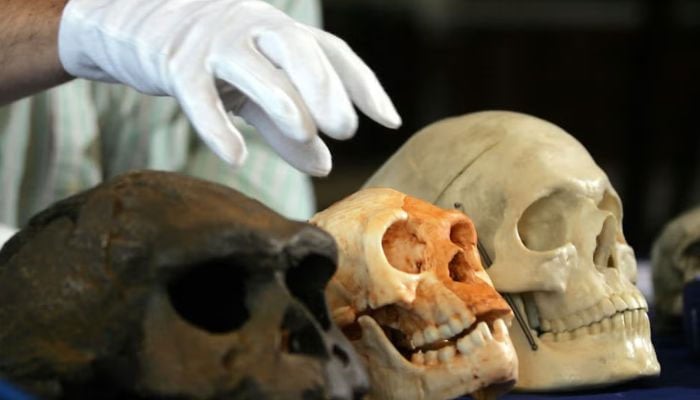
A new research study has challenged the understanding of what we know about our human relatives, named hobbits.
Earlier it was suggested that Homo floresiensis depended on hunting and mastered the art of using fire to survive in prehistoric times. However, new evidence suggests that Hobbits did not hunt large game like the Stegodon.
Instead, they likely scavenged carcasses already killed by Komodo dragons, which were the island's primary predators.
The findings were based on researchers comparing cut marks on Stegodon bones found in Liang Bua cave in the Indonesian island of Flores in 2003, showing teeth marks from a living Komodo dragon.
The markings were significantly similar, and human-made tool marks were found only on less desirable parts of the carcasses, indicating the primitive humans accessed the remains after the predators had finished.
According to Dr Elizabeth Grace who comprehensively studied how Homo floresiensis survived on an isolated island between about 190,000 and 50,000 years ago.
“I wanted to see if we really could show that H. floresiensis was the hunter that it had been portrayed as for decades,” said Veatch, lead author of the study.
As per study’s findings published in the journal Science Advances, the hobbits only survived through mastering the art of using “tools to scavenge Stegodon leftovers of the island’s sole carnivorous animal.”
Speaking about the ability to light the fire, the study suggests that unlike previous theories, there is no evidence that hobbits used fire to cook anything.
This research study showed significant implications for human evolution, showing that Homo floresiensis exhibited different behavioural repertoire compared to large-brained hominins like Homo erectus, Neanderthals, or Homo sapiens.
The findings also support the theory that hobbits may not be a dwarfed descendent of Homo erectus. In fact, it is possible that they may have descended from more primitive and small-brained ancestral groups.
The study also sparked a taxonomic debate, suggesting that Homo floresiensis may not belong in the genus Homo at all, though further evidence regarding their ancestry is needed to formally redesignate them.
“It reinforces the minority view that floresiensis does not really belong in the genus Homo and should be redesignated, although choosing a new genus name will not be straightforward without knowing more about its ancestry,” Veatch said.


-
 Hawaii’s Hōlei sea arch collapses after centuries on Big Island: What happened
 -
 Solar system may have a much shorter lifespan than we thought
 -
 Singapore builds world’s ultra-precise clock outperforming US, China
 -
 NASA expands Moon base research with three new investigations
 -
 Are Europe's data centres hiding their water use?
 -
 SpaceX set to send Google AI chips into space for data centers
 -
 New report warns of record ocean warming and rising seas
 -
 Why NASA scientists believe Scotland holds clues to Mars’ ancient past