James Webb Space Telescope reveals how black holes feed themselves
James Webb Space Telescope’s results suggest that black holes may be nature's cosmic recycler
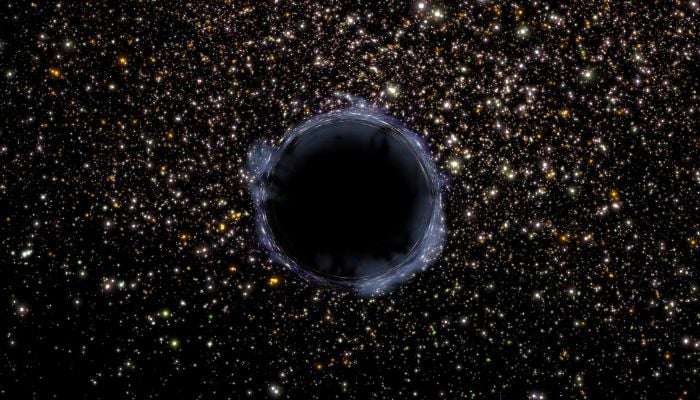
A gas filament stretching 800 light-years across, moving at roughly 1.3 million miles per hour, may finally explain one of astronomy's most stubborn puzzles: how supermassive black holes keep growing even as they appear to starve themselves.
A supermassive black hole sits at the centre of each galaxy, with some lying dormant while others are active and spewing matter out through jets.
The jets should cut off a black hole's fuel supply, but scientists have found black holes gaining billions of times the mass of our sun in the first billion years after the Big Bang, something impossible under current theories as they're ejecting their fuel.
According to one hypothesis, however, the ejected gas doesn't just disappear but cools down into thin filaments, less than a few hundred light-years wide, and then falls right back into the black hole to begin the process anew.
"James Webb Space Telescope’s (JWST's) results suggest that black holes may be nature's cosmic recycler," stated Julie Hlavacek-Larrondo of the Université de Montréal, who led the study from 2026.
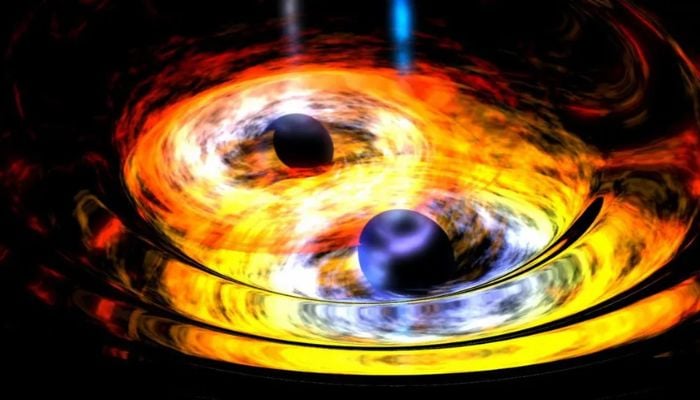
"They release enormous amounts of energy that heat their surroundings, yet that same gas can later cool into thin filaments that fall back inward and feed the black hole again."
To put their hypothesis to the test, the researchers used the NIRSpec instrument on board the JWST telescope to observe NGC 4696, the dominant galaxy in the Centaurus cluster, which is about 145 million light-years away from us. The Hubble Space Telescope had previously observed a peculiar, hook-like spiral of gas around the galaxy’s central black hole.
Using JWST, however, they discovered that the spiral was actually a spinning disc of gas measuring 800 light years in diameter, which was spinning at almost 600 km/s.
"JWST is now showing us the final link of this closed loop," said co-author Helen Russell of the University of Nottingham. "The vast filamentary network of gas flows ultimately funnels gas down to a disc that fuels the black hole."






-
 US finally confirms weapons in orbit: What it means for space warfare
 -
 How China's FAST telescope is mapping the cosmic gas behind star birth
 -
 Did Sun eat super-Earth? New study says maybe
 -
 Did Sun swallow a super-Earth? Scientists search for its ‘fingerprints’
 -
 Blue Origin sets sights on Mars with new NASA network
 -
 NASA, IBM launch open-source lunar foundation AI model to help map ice, craters on moon
 -
 Bacteria can remember without brain, new study finds
 -
 Fast radio bursts may unlock secrets of dark matter, energy and neutrinos