Fast radio bursts may unlock secrets of dark matter, energy and neutrinos
FRBs are intense and brief blasts of radio waves, originating from magnetars
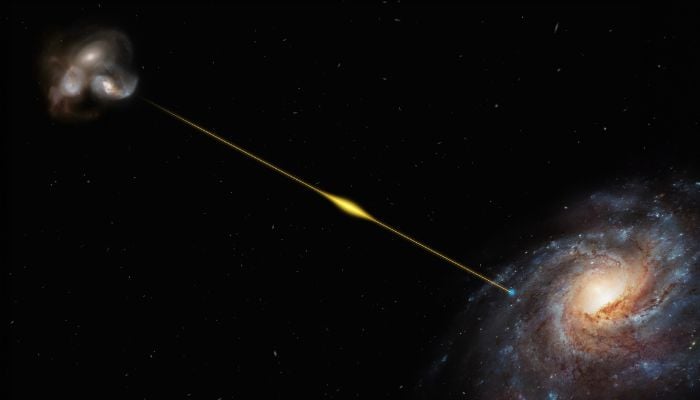
In a recent breakthrough, the scientists believe that fast radio bursts (FRB) could be helpful in unlocking long-held secrets of the cosmos and the Universe.
FRBs are intense and brief blasts of radio waves, originating from magnetars and they travel billions of light-years to Earth. As they pass through cosmic gas and dust, they collect fingerprints detailing how matter is distributed across the universe.
As per the researchers, the FRBs data could help them study cosmological mysteries including the true nature of dark matter, the acceleration driven by dark energy and mass of elusive neutrinos.
Kritti Sharma, a graduate student working with Vikram Ravi, a professor of astronomy at the California Institute of Technology and also part of the team, said in a statement, “We've established that FRBs are a leading probe of the distribution of matter in the universe.”
"These FRB data can be used to enhance cosmology experiments that are trying to answer questions about dark matter, dark energy, and the mass of neutrinos."
Through experiment in which the researchers analysed the sample of 100 FRBs to measure the impact of feedback from galaxies. This is the energy ejected from the centers of galaxies by supermassive black holes that smooths out surrounding matter.
They discovered that while galactic feedback plays a role in smoothing out surrounding matter and making it less clumpy. However, this suppressing effect is weaker than previously measured.
Ravi said, "The feedback process thins the gas around the galaxies, redistributing matter across vast distances. It smooths out clumps of matter in a way that looks astonishingly similar to what massive neutrinos do, or what dark energy or dark matter theories predict.”
"Unless scientists can independently measure this contribution from feedback, they can't tell these effects apart."
Caltech's Deep Synoptic Array (DSA) in Nevada is expected to detect tens of thousands of FRBs, providing a massive boost to cosmology research. It is scheduled to begin operations in 2029.


-
 Europe launched 8 orbital rockets last year, can it rival Starlink?
 -
 Japan launches world’s first mission to bring sample back from phobos
 -
 Orionid meteor shower 2026: Peak date, viewing tips and what to expect
 -
 Why Mars looks blue in NASA’s unedited curiosity panorama?
 -
 Blue Origin upgrades new Glenn rocket launch infrastructure to take on SpaceX
 -
 NASA’s next Mars mission targets Phobos and Deimos, not Red Planet
 -
 Is AI ready to rewrite our understanding of physics?
 -
 Astronomers identify possible first green star in 27 years of research