Astronomers identify possible first green star in 27 years of research
Warwick models suggest white dwarfs can glow pink, cyan, yellow or green, depending on what's in their atmospheres
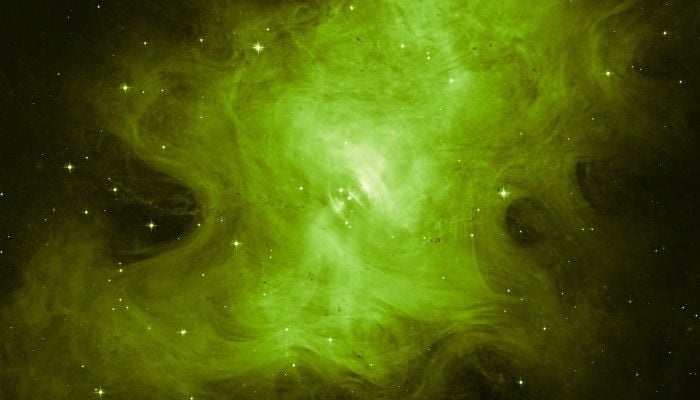
You'd expect a dead star to look white, and roughly 29 in 30 white dwarfs do. A team at the University of Warwick says the rest can glow pink, purple, yellow, cyan or even green. One of them may be the first green star anyone has credibly identified.
Star colours generally follow the principle of temperatures; the cool stars are orange, the Sun-type stars are white, while the hottest stars appear pale blue. Lead author Mark Hollands notes that most of the white dwarfs behave like "perfect radiators"; therefore, the same principle can be used in their case as well.
This recent research, published this week in RAS Techniques and Instruments 2026, explores all possibilities. As a result of the very high density of the white dwarfs, it becomes possible for some elements such as carbon, calcium, and sodium to interact with the helium plasma surrounding them.
How white dwarf becomes green?
The best case is provided by WD J1330+6435, which is located at a distance of 326 light-years away. The star has been feeding on its planetary companion, causing an accumulation of calcium, lithium, and sodium in the atmosphere.
According to the model created by the research team, the sodium absorbs the orange wavelengths of the spectrum, leaving only green radiation behind. As the scientists state, there has never been a credible report of any other green star, living or deceased.
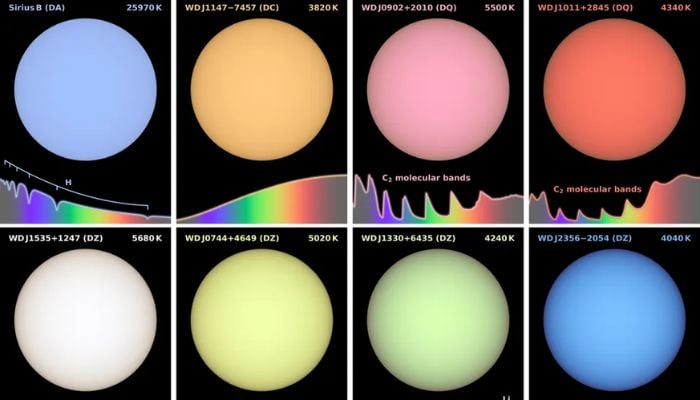
The carbon-bearing white dwarfs will have a pink or purple colour. The white dwarfs contaminated by the debris from asteroids, comets, and planets will be yellow. The cooler white dwarfs containing both helium and hydrogen in their atmosphere will appear to be cyan or light blue in colour.
At the red end, WD J1011+2845 is the star, only 48 light-years away from Earth, that brings carbon to its surface from its core, giving it a vivid salmon-pink colour.
How common are colourful white dwarfs?
Only five of the 151 white dwarfs within about 65 light-years have unusual colours. That works out to around one in 30. Co-author Boris Gänsicke says that across the whole population, the average white dwarf "is really white".
Billions of years from now, our sun will become a white dwarf. Whether it ever turns green would depend on whether anything is left to eat.


-
 New study sounds alarm as Doomsday Glacier melts more aggressively than thought
 -
 Hubble data hints at planet born after its star died
 -
 NASA to brief public on Artemis III mission progress
 -
 ‘Time capsule beneath the sea’: World’s oldest shipwreck holds secrets from Great Pyramid era
 -
 NASA spots mysterious V-shaped scar stretching 700 light-years across space
 -
 Space Jellyfish over Florida: What is that glowing cloud?
 -
 SpaceX Falcon 9 launches Dragon with 6,300 pounds of supplies to ISS
 -
 How far can a rover go? NASA’s Perseverance breaks Mars driving record