
Physicist discovers new solution to Einstein's equations for 'Black Saturn'
A Black Saturn features a spherical black hole surrounded by a ring-shaped black hole, with each possessing its own event horizon
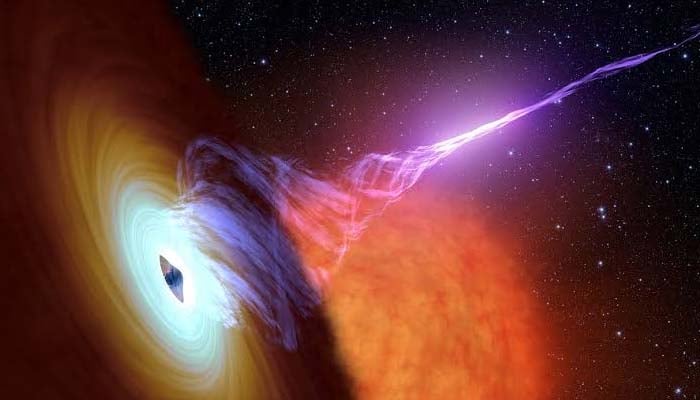
A theoretical physicist has developed the latest mathematical solution to Einstein's equations describing a bizarre configuration of two black holes in five-dimensional spacetime, which is called "Black Saturn."
The recently developed solution lets both black holes rotate in two independent planes at the same time, which was developed by Jay Armas of the University of Amsterdam, expanding previous mathematical models of the unusual configuration.
A Black Saturn features a spherical black hole surrounded by a ring-shaped black hole, with each possessing its own event horizon.
The ring's rotation helps prevent it from collapsing under its own gravity, while both black holes influence the surrounding spacetime.
In 2007, the first mathematical description of a Black Saturn was published but it only accounted for rotation in one plane.
Armas' latest research, published in a preprint on arXiv, launches a more complex model integrating rotation across both planes.
Moreover, the solution demonstrates that both black holes can simultaneously reach extremality, a state in which their Hawking temperatures drop to absolute zero while their event horizons remain intact.
However, the configuration cannot accomplish complete equilibrium due to the black holes unable to maintain matching rotations in both planes.
Although there is no evidence that Black Saturns exist in the universe, the study could help scientists probe gravity, spacetime geometry and the behaviour of black holes in higher dimensions.



-
 Thailand makes prepares to stop exporting rare earth mining chemicals to Myanmar
-
 Inside COP31 climate deal: COP31 President speaks out
-
 NASA reveals mysterious 'ghost forest' on Mars: Everything to know about it
-
 COP31 talks reach deadlock amid growing fossil fuel dispute
-
 Astronomers observe massive puffy star merging with smaller companion
-
 NASA confirms Voyager 1 is now a ‘light-day’ away from Earth
-
 Google partners with Bezos’ Blue Origin to launch AI computing satellites in 2029
-
 ‘Craziest is definitely still yet to come’: HEO unveils advanced space intelligence platform in major new launch


