Scientists find hidden structure inside Orion Nebula
Scientists also found a hydrogen gas filament four light years away from the edge of the western side of the shell
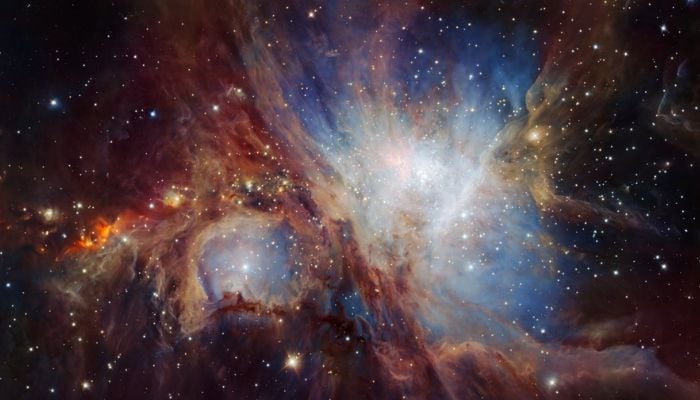
Astronomers thought they had the Orion Nebula figured out. A new study says one of its most basic measurements was wrong by nearly a factor of ten, and there's a second hidden structure inside it no one had cataloged before.
Published in Astronomy and Astrophysics, the research was led by Juan Diego Soler at the University of Vienna, using two of the world's most advanced radio telescopes: the Karl G. Jansky Very Large Array in New Mexico and the FAST telescope in China.
Together, they produced an image of neutral atomic hydrogen, which produces a 21-centimetre-wavelength radio emission, within the outer shell of the nebula with a resolution that was unprecedented for any previous survey.
Previous calculations, using carbon ions in the region, estimated the mass of the front half of the shell to be about 1,100 solar masses. According to the new images of hydrogen, this number was more like 100 solar masses.
“Determining mass is a fundamental step,” Soler noted, because this affects how scientists will determine the efficiency of young stars in carving out their environment via wind and radiation.
The team notes some of the missing mass may be hiding in molecular hydrogen, which neither survey method can detect directly.
Moreover, the map showed an imbalance in gas distribution, indicating a previously unknown small cavity within the larger one. Scientists looked up star catalogues to find out a source at its centre but found no match, implying that the source responsible for carving the cavity is not one of those usually considered by scientists.
According to Daniel Seifried of the University of Cologne, one of the co-authors of this study, the results pose serious challenges to current theoretical models explaining the influence of massive stars on the environment around them.
Scientists also found a hydrogen gas filament four light years away from the edge of the western side of the shell with 80 solar masses but not associated with any cluster of young stars. It still needs to be determined how it originated, whether it is gas leaking through an opening in the shell or remnants of the earlier cloud surrounding the bubble.






-
 US finally confirms weapons in orbit: What it means for space warfare
 -
 How China's FAST telescope is mapping the cosmic gas behind star birth
 -
 Did Sun eat super-Earth? New study says maybe
 -
 Did Sun swallow a super-Earth? Scientists search for its ‘fingerprints’
 -
 Blue Origin sets sights on Mars with new NASA network
 -
 NASA, IBM launch open-source lunar foundation AI model to help map ice, craters on moon
 -
 Bacteria can remember without brain, new study finds
 -
 Fast radio bursts may unlock secrets of dark matter, energy and neutrinos