Why China is crashing a spacecraft into asteroid 2015 XF261
Till now, 2015 XF261 has been tracked in just 74 observations
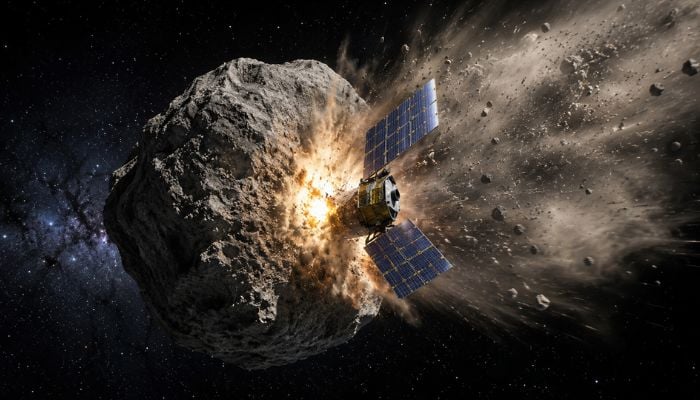
China is set to launch a bold plan, aiming to protect the Earth from potentially disastrous space rocks.
The mission includes crashing a spacecraft into an asteroid by 2030 as a part of testing the various methods to defend the planet.
Earlier, NASA hit a milestone when the US-based space agency in its 2022 Dart test successfully shifted the asteroid Dimorphos onto a slightly altered path around the Sun.
But the China-based mission is quite different because it aims to not only directly change the path of the 30 meter wide asteroid but also break apart its structure. This mission holds a significant importance as such killer asteroids could jeopardise the extinction of human civilization if they hit the Earth.
Unlike NASA's DART mission, which targeted a "rubble pile" asteroid, the Chinese space program plans to strike a solid asteroid.
Chinese researchers will deliberately crash a spacecraft into 2015 XF261 which is a small near-Earth asteroid that shares an orbit similar to Earth’s. The space rock is set for a close planetary flyby around 2030.
If the collision proves successful, scientists will be able to measure the resulting alteration in the asteroid's solar orbit to test planetary defense capabilities.
Unlike the Dart mission, the project will launch two spacecraft at one time, as per new study that is currently under review by the Journal of Deep Space Exploration.
Between two, one spacecraft will crash into the asteroid at over 26 times the speed of sound and the second one will only observe the impact at every stage from a safe distance. It will remain in space for years to monitor the asteroid and send images back to the Earth.
Besides assessing the impacts, the probe will also try to unravel mysteries surrounding asteroids including their true nature, gravity, layering, composition and density.
However, the mission is also going to deal with various challenges. The major one is detecting the asteroid as over the past decade, 2015 XF261 has been tracked in just 74 observations.
“Dart was the first to demonstrate asteroid deflection by kinetic impact in space but it did not directly change an asteroid's orbit around the Sun relative to Earth, making it different from a real planetary defence scenario," researchers from the China National Space Administration wrote in the new study.
"Such missions would provide an unprecedented opportunity to investigate the internal structure, composition, and mechanical properties of near-Earth asteroids," the study notes.






-
 US finally confirms weapons in orbit: What it means for space warfare
 -
 How China's FAST telescope is mapping the cosmic gas behind star birth
 -
 Did Sun eat super-Earth? New study says maybe
 -
 Did Sun swallow a super-Earth? Scientists search for its ‘fingerprints’
 -
 Blue Origin sets sights on Mars with new NASA network
 -
 NASA, IBM launch open-source lunar foundation AI model to help map ice, craters on moon
 -
 Bacteria can remember without brain, new study finds
 -
 Fast radio bursts may unlock secrets of dark matter, energy and neutrinos