Four hidden dead stars found in Earth's backyard
Astronomers have found hidden white dwarfs within 65 light-years of Earth, including one that's now the ninth-closest dead star to the sun
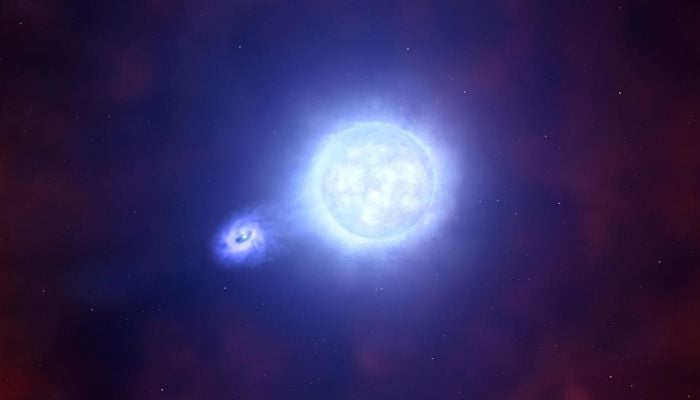
Four dead stars have been hiding in plain sight within 65 light-years of Earth, astronomers have confirmed, tucked behind the glare of brighter companion stars for decades.
Scientists from the Universities of Warwick and Colorado Boulder made the direct observation of the white dwarfs via the Hubble Space Telescope, their results being published in the MNRAS journal.
White dwarfs represent the remnants of the sun-like stars after burning out all their fuel. Our sun, too, is going to be a white dwarf in about five billion years.
The four recently discovered white dwarfs were not observed before because each of them was circling a red dwarf, a smaller star that emits light in the visible spectrum sufficiently bright to obscure the light of its companion.
Dr Mairi O'Brien, a research fellow from the University of Warwick who led the study, stated that it is usually quite easy to identify nearby isolated white dwarfs; however, these particular four needed observations in ultraviolet radiation to do it.
The unusual binary system G 203-47 caught the attention of researchers not because of its closeness alone. This binary system is located at 25 light-years from the Earth and is now counted as the ninth-closest known white dwarf to the Sun. The red dwarf in this system revolves around the white dwarf every 14.9 days, while it revolves around itself only once in 100+ days.
According to Dr David Wilson of Colorado Boulder, this asymmetry is an indication that these binary systems have evolved through different routes, with some being locked as a result of violent processes, while others, like G203-47, evolved through mild and shorter collisions.
According to Professor Pier-Emmanuel Tremblay of Warwick, there may be about nine to ten such binary systems existing in the nearby space, as only a few per cent of the known red dwarfs have been systematically scanned for companions.
It is possible that some of these unknown objects may be brown dwarfs which failed to become a star.






-
 US finally confirms weapons in orbit: What it means for space warfare
 -
 How China's FAST telescope is mapping the cosmic gas behind star birth
 -
 Did Sun eat super-Earth? New study says maybe
 -
 Did Sun swallow a super-Earth? Scientists search for its ‘fingerprints’
 -
 Blue Origin sets sights on Mars with new NASA network
 -
 NASA, IBM launch open-source lunar foundation AI model to help map ice, craters on moon
 -
 Bacteria can remember without brain, new study finds
 -
 Fast radio bursts may unlock secrets of dark matter, energy and neutrinos