Astronomers just solved a 10-billion-year-old Milky Way mystery
Milky Way suffered a head-on collision with a dwarf galaxy known as the Gaia Sausage
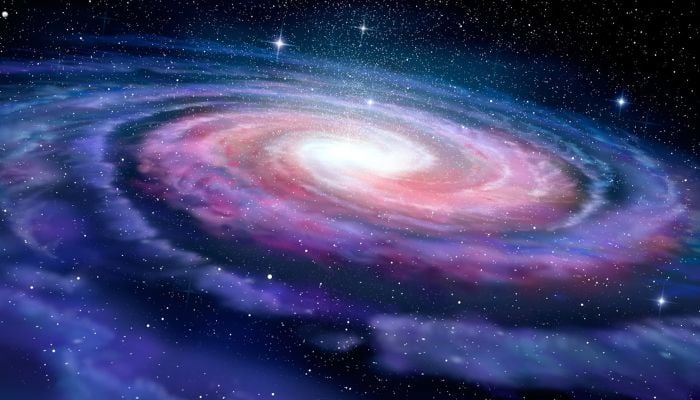
Astronomers have found evidence related to the Milky Way’s incident of flipping on its side.
Around 10 years ago, the galaxy suffered a head-on collision with a dwarf galaxy known as the Gaia Sausage. As a result of this collision, the Milky Way’s entire disc was flipped by more than 90 degrees into its current orientation.
As per researchers, the disc flip process took a few hundred million years.
In the study led by Durham University researchers, they employed computer simulations to explain why stars in our galaxy’s stellar halo rotate at very slow speed, about 25 km/s, compared to stars in the galactic disc which rotates around the speed of 220 km/s.
According to findings after studying 25 similar galaxies, the team found two key features shown by slowly rotating haloes. The first one is a head-on collision with another galaxy and the second one is disc flip.
Researchers will present the further details this week at the Royal Astronomical Society’s National Astronomy meeting in Birmingham.
Astronomers first discovered this ancient collision in 2018 using data from the ESA's Gaia mission. The interloper dwarf galaxy was torn to shreds and absorbed by the Milky Way. Despite being a dwarf galaxy, it had stars, gas, and dark matter totaling more than 10 billion times the mass of the sun.
"A disc flip also means most of the Milky Way's stars once moved on very different trajectories than they do today – possibly even our own Sun, meaning our 'stable' spot in the galaxy might not have been so stable for the Solar System's whole lifetime," Kirill Batrakov, the lead author of study said.
As per observations, this collision was the Milky Way’s last significant merger that reshaped the galaxy by developing the central bulge and dominating the stellar halo.
"Finding that its disc flipped adds a new chapter to that story, one we must account for when placing the Milky Way in a broader context of other galaxies.”
"What excites me the most is that this complex history can be reconstructed just from present-day observations,” he added
In future, the Milky Way would experience further mergers. This includes a merger with the Large Magellanic Cloud in a few billion years.






-
 US finally confirms weapons in orbit: What it means for space warfare
 -
 How China's FAST telescope is mapping the cosmic gas behind star birth
 -
 Did Sun eat super-Earth? New study says maybe
 -
 Did Sun swallow a super-Earth? Scientists search for its ‘fingerprints’
 -
 Blue Origin sets sights on Mars with new NASA network
 -
 NASA, IBM launch open-source lunar foundation AI model to help map ice, craters on moon
 -
 Bacteria can remember without brain, new study finds
 -
 Fast radio bursts may unlock secrets of dark matter, energy and neutrinos