
Pakistan downed five Indian jets: BJP leader
PAF deployed Chinese fighter jets which outperformed French-made aircrafts, says Swamy
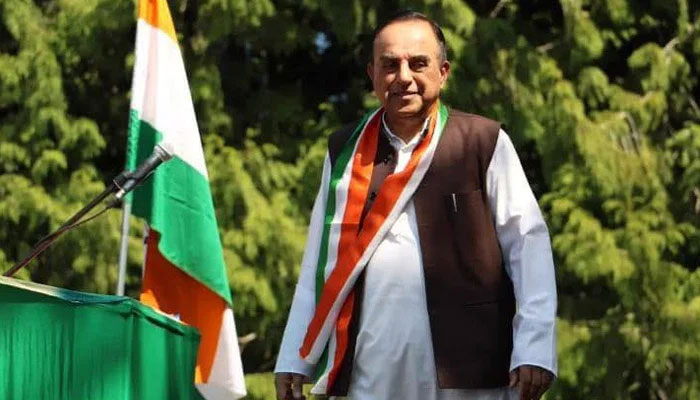
NEW DELHI/DUSHANBE: In a rare and candid admission, senior BJP leader Subramanian Swamy has acknowledged that Pakistan shot down five Indian Air Force (IAF) jets during the recent conflict.
Speaking in an interview, Swamy said the Indian planes were defeated in air combat, as Pakistan deployed Chinese fighter jets which outperformed the French-made aircraft used by New Delhi, reports Geo News.
“Pakistan downed five of our planes. They used Chinese planes to down our planes, which were French,” Swamy revealed.
“The Chinese planes were good, but the French were not. Rafale is not up to the mark as per India’s needs,” he added, criticising the performance of the highly-touted Rafale jets. He went on to make a startling claim regarding the controversial Rafale deal, alleging corruption in the procurement process. “Corruption happened in Rafale which won’t be investigated till Modi is the PM,” he stated firmly.
Discussing the lack of accountability within the Indian leadership, Swamy said under the current prime minister, an open probe into the aircraft losses was highly unlikely.
“With Modi in power, no discussions or investigations will happen about how and why those jets were downed,” he said.
The military confrontation between the two countries was triggered by last month’s attack in Indian Illegally Occupied Jammu and Kashmir (IIOJ&K) that left 26 tourists dead, with India blaming Pakistan for the attack without offering any evidence.
Earlier this month, Pakistan’s armed forces launched a large-scale retaliatory military action, named “Operation Bunyan-um-Marsoos”, and targeted several Indian military targets across multiple regions.
Pakistan downed six IAF fighter jets, including three Rafale, and dozens of drones. After at least 87 hours, the war between the two nuclear-armed nations ended on May 10 with a ceasefire agreement brokered by the United States.
When asked about the downing of Indian jets during the conflict, Indian Air Marshal AK Bharti had said that “losses are a part of combat,” without providing further details.
“[I] would not like to comment as we are still in air combat situation. It will be advantage for the adversary. We have achieved our objectives. All our pilots are back home,” he had claimed as reported by NDTV.
According to the ISPR, a total of 53 individuals, including 13 personnel of the armed forces and 40 civilians, were martyred in Indian strikes during the recent military confrontation.
On the other hand, for the first time, France’s armed forces ministry has said it is in contact with the Indian government to “better understand” the circumstances surrounding French-origin aircraft during the recent hostilities between India and Pakistan, the international media reported
At a press conference in Paris the other day, a spokesperson for the French defence ministry said the situation remained unclear and that Paris was attempting to make sense of conflicting accounts.
“Regarding the conflict taking place between India and Pakistan, what I mainly observe is that we are in the fog of war and that there is an intense information war. In other words, what we know most of all today is that we don’t know what happened. So indeed, there are a number of allegations that I will not repeat, since there is no confirmed information,” the spokesperson said.
“The issue of the Rafale is, of course, of primary importance to us. We are naturally keen to understand what happened, and so we are trying to stay as close as possible to our Indian partner to better understand the situation,” the spokesperson added.
“Obviously, the most significant feedback will come from this use in high-intensity combat, which apparently, according to some reports, involved several hundred aircraft. So, of course, we are following these events as closely as possible,” the spokesperson said.
Noting that the Rafale had seen two decades of active service across various theatres of war, the official said any confirmation of a combat loss would mark a first in the aircraft’s operational history. “What we can especially note today is that the Rafale has seen 20 years of operational use – 20 years of combat deployment – and that if it turns out there was indeed a loss, it would be the first combat loss of this warplane.”
Reuters adds: In a latest statement, Indian Defence Minister Rajnath Singh said the country will use the firepower of its navy in response to any future “aggression” by Pakistan.
“If Pakistan resorts to anything evil or unethical, it will, this time, face the firepower and ire of the Indian Navy,” he said on aircraft carrier INS Vikrant off the coast of the western Indian state of Goa.
A spokesperson for Pakistan’s military referred Reuters to a May 12 statement, which said there would be a “comprehensive and decisive” response whenever Pakistan’s sovereignty was “threatened and territorial integrity violated”.
The Indian Navy deployed its carrier battle group, submarines and other aviation assets in the northern Arabian Sea within 96 hours of the April 22 attack.
Defence Minister Singh said ‘Operation Sindoor’, under which India launched the strikes on Pakistan, was paused, but not yet over.
“We stopped our military actions on our own terms. Our forces had not even started showing their might,” he said.
In a closely related development, Chairman Joint Chiefs of Staff Committee (CJCSC) General Sahir Shamshad Mirza Friday said Pakistan and India were close to reducing the troop buildup on the border to the levels before conflict, although he warned the crisis had increased the risk of escalation in future.
The CJCSC said the two militaries had started the process of drawing down troop levels.
“We have almost come back to the pre-22nd April situation... we are approaching that, or we must have approached that by now,” said Gen Mirza.
Gen Mirza, who is in Singapore to attend the Shangri-La Dialogue forum, said while there was no move towards nuclear weapons during this conflict, it was a dangerous situation.
“Nothing happened this time,” he said. “But you can’t rule out any strategic miscalculation at any time, because when the crisis is on, the responses are different.”
He also said the risk of escalation in future had increased since the fighting this time was not limited to the Occupied Kashmir.
The rapid escalation of hostilities ended in part because of behind-the-scenes diplomacy involving the US, India and Pakistan, and the key role played by Washington in brokering peace. India has denied any third-party role in the ceasefire and said any engagement between Pakistan and India had to be bilateral.
However, Gen Shamshad warned that international mediation might be difficult in future because of a lack of crisis management mechanisms between the countries.
“The time window for the international community to intervene would now be very less, and I would say that damage and destruction may take place even before that time window is exploited by the international community,” he said.
Pakistan was open to dialogue, he added, but beyond a crisis hotline between the directors general of military operations (DGMOs) and some hotlines at the tactical level on the border, there was no other communication between the two countries.
India’s foreign ministry spokesperson said on Thursday, “talks and terror don’t go together” in response to a question on the possibility of dialogue with Pakistan.
Gen Mirza also said there were no backchannel discussions, or informal talks, to ease tensions. He also said he had no plans to meet General Anil Chauhan, India’s chief of defence staff, who is also in Singapore for the Shangri-La forum.
“These issues can only be resolved by dialogue and consultations, on the table. They cannot be resolved on the battlefield,” Gen Mirza said.
APP adds: In yet another related development, Prime Minister Shehbaz Sharif Friday rejected the weaponisation of water and warned that Pakistan would not allow India to cross the red line by holding the Indus Waters Treaty in abeyance and endangering millions of lives for narrow political gains.
“India’s unilateral and illegal decision to hold in abeyance the Indus Water Treaty, which governs the sharing of the Indus Basin water, is deeply regrettable.
Millions of lives must not be held hostage to narrow political gains, and Pakistan will not allow this. We will never allow the red line to be crossed,” the prime minister said while addressing the three-day High-Level International Conference on Glaciers Preservation being held in Dushanbe from May 29-31.
The conference is being attended by over 2,500 delegates from 80 UN member states and 70 international organizations, including prime ministers, vice presidents, ministers, and UN assistant secretaries-general.
In his comprehensive address, Shehbaz touched all the relevant issues, including glacial preservation, Pakistan’s climate vulnerability, 2022 floods in Pakistan, global climate action and responsibility, scientific projections on glacial melt, weaponisation of water and call to protect nature and humanity’s shared destiny.
“The world today bears fresh scars from the use of conventional weapons in Gaza that have left deep wounds.
As if that were not enough, we are now witnessing an alarming new low “the weaponisation of water,” he told the international conference being hosted by Government of Tajikistan in collaboration with the United Nations, Unesco, WMO, the Asian Development Bank, and other key partners as a historic moment for climate ambition, glacier preservation, and international cooperation.
“The five great rivers that shape our geographical landscape — Indus, Jhelum, Chenab, Ravi, and Sutlej — all depend on the stability of glacial systems.
This makes Pakistan one of the most vulnerable countries to any climatic changes that impact glaciers,” he added.
He told the international gathering that Pakistan had faced the peril of glacial melt in the form of devastating floods in 2022 which destroyed millions of acres of standing crops, hundreds of thousands of houses and infrastructure, despite Pakistan’s only less than half a percent contribution of the total world emissions and yet being one of the 10 most vulnerable countries.
Referring to the “sobering” scientific projections, he highlighted that the glacial melt in our region was expected to accelerate flooding in the coming decades, followed by a drastic decline in river flows as glaciers recede further.
Meanwhile, paying tribute to the martyrs of Operation ‘Bunyanum Marsoos’ and expressing complete solidarity with their family members, Field Marshal Asim Munir said under the national leadership, the people of Pakistan became a wall of steel for the defence of the motherland, reports ISPR.
He said this during his visit to the Command and Staff College Quetta where he addressed the student officers and faculty.
Praising professionalism of the armed forces, the COAS reiterated that the success of ‘Ma’arka-e-Haq’ testified “to our national resolve, and complete synergy among all elements of national power.”
Commenting on the global and regional environment, the COAS shed light on the character of emerging conflict, with particular emphasis on India’s increasingly dangerous propensity to use unprovoked military aggression against Pakistan.
Reiterating the resolve to defeat any aggression and ability to deal with threats across the entire conflict spectrum, the COAS asserted that Pakistan will never be coerced and inimical designs to distract its efforts against war on terrorism will be comprehensively defeated.
For strategic stability of South Asia, the COAS emphasized the need for peaceful resolution of longstanding internationally recognized Kashmir dispute, and warned against the unlawful and legally untenable ‘hydro terrorism’ by India.
Highlighting Indian state’s role in sponsoring terrorism inside Pakistan, the COAS commented on the reinvigorated counter terrorism drive and expressed confidence that nation’s fight against terrorism will be driven to a logical conclusion - success against all forms and manifestations of terrorism.
Talking about leadership, the field marshal advised the student officers to fulfill their obligations with utmost dedication, passion and resolve. Emphasizing the need for innovative thinking and research, he lauded the Command & Staff College Quetta for grooming future military leaders who uphold the highest standards of this sacred profession.
“Training must reflect not only the current realities but also prepare us for the future battlefield, one that demands agility, innovation, and unwavering resolve,” he remarked.







-
 Why Attorney Says Justin Baldoni 'not Off The Hook' Despite Court Ruling? Report
 -
 'Abuses' Shouted At Andrew Mountbatten-Windsor As Protesters Breach Security
 -
 Jenna Dewan Reveals Mindset She Follows When Life Gets 'nuts'
 -
 Erika Kirk Dating Claims Surface As She Reclaims Charlie Kirk's Legacy
 -
 Karoline Leavitt Joins Erika Kirk At Washington Event
 -
 Princess Beatrice’s Husband Edo ‘questioning Marriage’: ‘His Standing & Status Is Impacted’
 -
 Petition To Strip Blake Lively Of 'It Ends With Us' PGA Credit Gains Massive Support
 -
 New Development In Blake Lively Lawsuit After Judge Dismisses Major Claims
 -
 Blake Lively, Taylor Swift Texts Resurface After Court Ruling
 -
 Prince Harry’s Behavior Towards Queen Elizabeth Gets Exposed: ‘He Drove Her To Paranoia’
 -
 Blake Lively, Justin Baldoni's Legal Case Receives Latest Update
 -
 Kylie Jenner Says Goodbye To Her Halloween Era: 'I've Retired It'
 -
 Mel B Reveals Why Spice Girls Documentary May Never Happen
 -
 Maggie Gyllenhaal Recalls Emotional Impact Of Seeing Husband With Other Woman
 -
 Scarlett Johansson Shares Wild First Concert Story
 -
 Inside King Charles, Queen Camilla's First US State Visit