
Kuwait to invest in Ghazi Barotha Hydropower Project
ISLAMABAD: Kuwait will buy stakes in the 1,450 MW Ghazi Barotha Hydropower Project (GBHP) and to this effect, EnerTech, which is a wholly-owned subsidiary of the Kuwait Investment Authority, and Wapda would appoint transaction advisers for the smooth divestment of 30 percent shares in the mega project.
The government wants to raise $800-900 million by selling out 30 percent of equity in the Ghazi Barotha Hydropower Project.
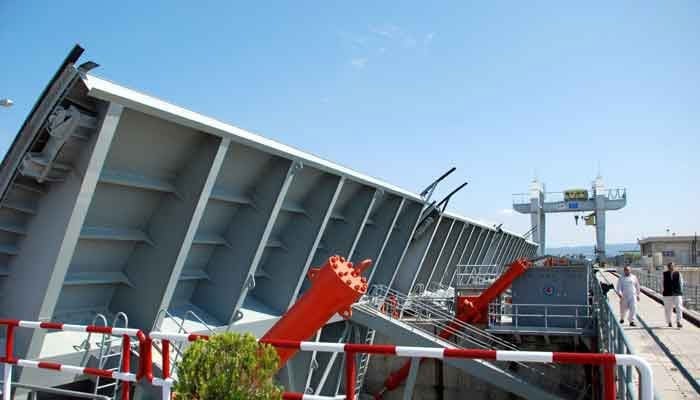
“The financing to be raised through divestment will be used for the Diamer-Bhasha Dam. EnerTech would conduct legal, financial and technical due diligence on Ghazi Barotha Hydropower Project,” senior officials in the water resources ministry and Wapda told The News.
In addition, Pakistan and Kuwait had signed on November 29 several MoUs worth multi-billion dollars in various sectors, including food security, agriculture, hydel power, water supplies and the establishment of a mining fund to support mineral industry and technology zone development.
Prime Minister Anwaar-ul-Haq Kakar and Chief of Army Staff General Asim Munir had also witnessed the signing ceremony in Kuwait.
Both EnerTech and the Government of Pakistan through the Water Resources Ministry had signed the investment cooperation agreement on the Ghazi Barotha Hydropower project on November 29, 2023 in Kuwait.
Pakistan is facing a financing gap of $3.5 billion for the Diamer-Bhasha Dam in the wake of lack of interest shown by the Islamic Development Bank, SFD (Saudi Fund for Development) and ADB (Asian Development Bank).
As per the minutes of SIFC’s Apex Committee meeting held on November 30, 2023, the Islamic Development Bank and ADB have been approached to seek support for bridging the financing gap of $3.5 billion for the Diamer-Bhasha Dam project, but MDBs (multi-development banks) are yet to show willingness as anchor financiers.
However, a new bankable financing structure for the dam for availing foreign investment has been prepared by HBL and EY (Ernst and Young). It should be pitched to potential investors to attract investment.
“The divestment of 30 percent equity of Ghazi Barotha Hydropower Project would be based on a profit-sharing basis,” official sources said, adding that the caretaker federal minister for water resources had earlier briefed the chief of army staff on the divestment of 30 percent equity plan of GBHPP worked out by the Technical Wing of the Water Resources Ministry.
Before he visited Kuwait, the COAS had appreciated the plan and its proposed execution and asked the SIFC to start consultations on this unique plan with the power, finance divisions and NEPRA.
The Ghazi Barotha Hydropower Project is a golden goose, as it continues to generate electricity in the summer and winter seasons with an average hydroelectric generation of 800 MWs. The project can generate 1,450 MWs in the summer, but in the winter, the generation of electricity fluctuates depending upon water flows in the Indus downstream of Tarbela Dam. However, during the peak of the ongoing winter season, the project still generates 1,450 MWs for four hours. GBHPP produces 6.7 billion units in a year, and the government would sell out electricity directly to the export industry of the country under the CTBCM model of 450 MWs, which is 30 percent of the total hydroelectric generation of the project. This is how this would be the pilot project that will provide electricity to the export industry by using the transmission and distribution system of NTDC and relevant DISCOs. This will reduce the current tariff of the export industry, which will help reduce the input cost of the industry and boost exports for the country.
The tariff for the Ghazi Barotha Hydropower Project currently stands at Rs1.25 per unit, but the Water and Resources Ministry wants NEPRA to increase its tariff to Rs10 per unit as base tariff for 30 percent generation of the project; it is enough to generate ample attraction to potential investors from friendly countries. If the regulator increases its tariff to Rs10 per unit, the 30 percent equity would generate $700-800 million and if it increases to Rs20-25 per unit, doling out the 30 percent equity would fetch $1.6-1.8 billion. However, under the plan, the authorities want NEPRA to increase the base tariff of 30 percent of the GBHPP up to Rs10 per unit. After that, the government would hold competitive bidding between export sector players seeking tariff rates above Rs10 per unit. If it gets implemented, it will be a win-win situation for both the export industry, Ghazi Barotha Hydropower Project management and foreign investors.


