
New discovery hints at formation of ‘moon factory’ around distant exoplanet
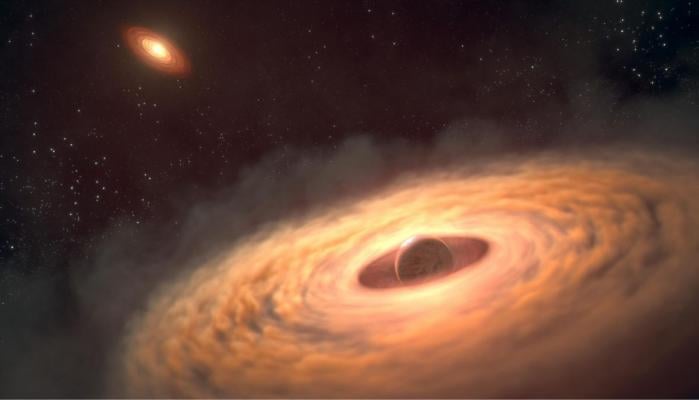
The hidden moon factory is a carbon-rich disk of dust and gas observed recently
Scientists have studied our solar system, which is home to eight major planets and more than 400 known moons orbiting six of them, to understand the new phase of the moon formation observed around a distant exoplanet.
This compelling revelation offers insights into how large moons, such as Jupiter’s for Galilean satellite, could have formed from a disk of dust and gas that surrounded the planet as it took shape.
This process would have taken place over 4 billion years ago and left subtle indications today.
NASA’s James Webb Space Telescope has captured the first direct look at material within a disk encircling a massive planet more than 625 light-years from Earth.
This carbon-rich disk may serve as a kind of workshop where moons take shape, moons are thought to outnumber celestial bodies across our galaxy, studying how they form is crucial to understanding our planetary system.
The discovery offers an understanding of the full history of the planetary system. This carbon-rich disk, found around the planet known as CT Cha b about 625 light-years from Earth, could be a birthplace for new moons.






-
 Will Smith surprises wife Jada Pinkett with unusual gift on Valentine's Day
 -
 James Van Der Beek's friends helped fund ranch purchase before his death at 48
 -
 Brooklyn Beckham hits back at Gordon Ramsay with subtle move over remark on his personal life
 -
 Jennifer Love Hewitt reminisces about workign with Betty White
 -
 Can Sydney Sweeney's brand compete with Kim Kardashian's SKIMS? Expert reveals
 -
 Kim Kardashian, Lewis Hamilton's romance being called a calculated move?
 -
 David, Victoria Beckham melt hearts with sweet Valentine's Day throwbacks
 -
 Valentine’s day on X: New animation rolls out for seasonal mentions