Asteroid hit China 10,000 years ago with power of 40 atomic bombs
A massive meteorite crater has been discovered
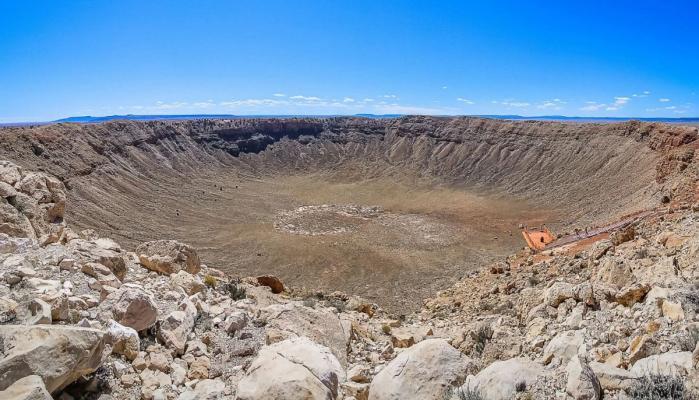
Researchers have confirmed the discovery of a massive asteroid strike that created a conspicuous crater in southern China’s Guangdong province approximately 10,000 years ago, during a period of a hypervelocity extraterrestrial impact.
The Jinlin crater, situated near Zhauqing city, is the fifth confirmed impact site in China and the very first recognized in the country’s southern region.
Measured at approximately 2,950 feet across, the crater further suggests that it was created by an interstellar object roughly 100 feet in diameter, with an explosive force equivalent to dozens of atomic bombs.
The impact would have significant influence on the surrounding environment, land sculpting, and local ecosystems.
The Jinlin carter was recently explained in the journal Matter and Radiation at Extremes on October 15, and its formation is attributed to a bolide impact.
In this connection, a researcher at the Centre for High Pressure Science and Technology, Chen Ming, said that the impact dissipates energy equivalent to 600,000 tons of TNT-comparable to the force of 40 Hiroshima-sized atomic bombs.
It has been observed that a major asteroid impact during this period could have transformative effects on the surrounding environment.
While asteroid impacts can occur anywhere on Earth, many ancient craters have been obliterated, distorted or buried over time due to crustal movement and surface weathering.
As reported by the South China Morning Post, researchers have identified around 200 impact craters globally with only five confirmed in China.
Evidence of Granite Shock found in Southern China crater
The formation was primarily caused by an asteroid impact, and analysis showed that quartz samples from the site contained planar deformation features-microscopic planes of damage that form when a crystal’s lattice structure is fragmented under extreme pressure and temperature.
On the contrary, these features can only stem from the severe conditions generated by an event impossible under normal terrestrial conditions.
The study results demonstrated that the intriguing discovery of microscopic deformation features in quartz provides irrefutable evidence that the Jinlin crater formed by an asteroid impact.
It is located in the region that receives more than 59 inches of rainfall annually and is specifically exposed to erosion, especially along the crater’s loose material.
The intriguing discovery is the first confirmed impact crater in South China. Further studies may suggest that carbon dating is needed to scrutinize its exact age.
This research is also a crucial point for potentially finding hidden impact structures by analyzing their earth structure and the extent of erosion.


-
 Andrew Garfield turned against ChatGPT after playing Sam Altman
 -
 Dua Lipa interview about children and Callum Turner is fake
 -
 Olivia Rodrigo wishes for normal life amid frustration over dating rumours
 -
 ‘The Social Network’ screenwriter reveals why he made another movie about Facebook
 -
 Marco Rubio to issue urgent warning on the future of Western civilization
 -
 Thailand-US trade deal nears completion: What to know
 -
 Eric Trump predicts AI boom will fuel a crypto surge
 -
 Xbox denies GTA 6 streaming rights: Here’s what happened