3I/ATLAS vanishes behind Sun, new images reveal strange activity
NASA has since classified the object as a potential threat to Earth
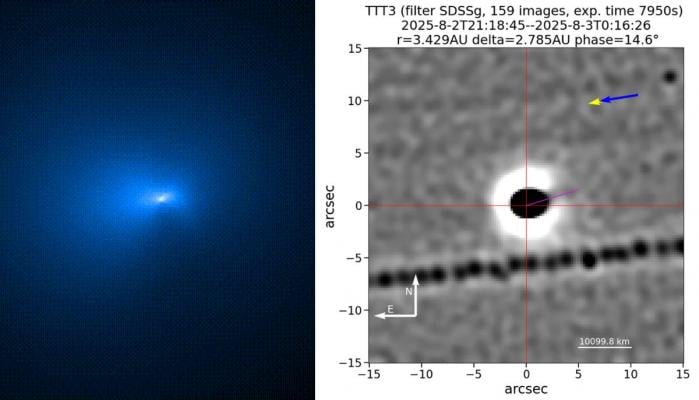
Humanity’s third detected interstellar visitor ever detected has kept astronomers on edge with mysterious behaviour.
The latest images have revealed another unusual activity from 3I/ATLAS, prompting the National Aeronautics and Space Administration (NASA) to activate the planetary defense mechanisms.
The images captured on August 2 by the Two-meter Twin Telescope (TTT) at the Teide Observatory in Spain’s Canary Islands show that the object reserved its thrust near the sun.
The images show the alien object emitting a stream of gas and dust toward the sun, rather than away from it.
3I/ATLAS, first discovered by NASA in June, originated from another solar system and it is the largest interstellar comet to have crossed our path.
The latest images, not yet published in a peer-reviewed study, were composed by combining 159 exposures lasting 50 seconds each.
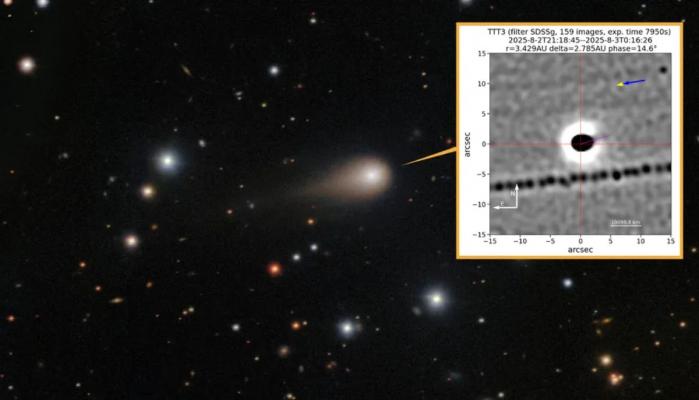
The images shared by The Astronomer’s Telegram on October 15, 2025, shows a large, high-speed jet of material blasting off the comet in the direction of the sun.
For now, the alien comet has vanished behind the sun where Earth’s telescopes can not see it.
NASA has since classified the object as a potential threat to Earth, adding it to the Comet Astrometry Campaign.


-
 Samantha Markle reveals what she knows as father faces FBI over child pornography
 -
 What happened to child pornography stash found with Thomas Markle?
 -
 Ariana Grande gets a new look ahead of 'Focker-in-Law' release
 -
 Is Billie Eilish entering a new music era?
 -
 Miley Cyrus did something unexpected for her fan
 -
 Jenna Ortega makes surprising confession about 'Wednesday' success
 -
 JD Vance defends Musk on Starlink amid rising Ukraine tensions
 -
 Elon Musk invests in Ellison’s Skydance media company: Here’s why