
Europe’s longest dinosaur trackway discovered in Oxfordshire quarry
The footprints date back to the Middle Jurassic Period about 166 million years ago
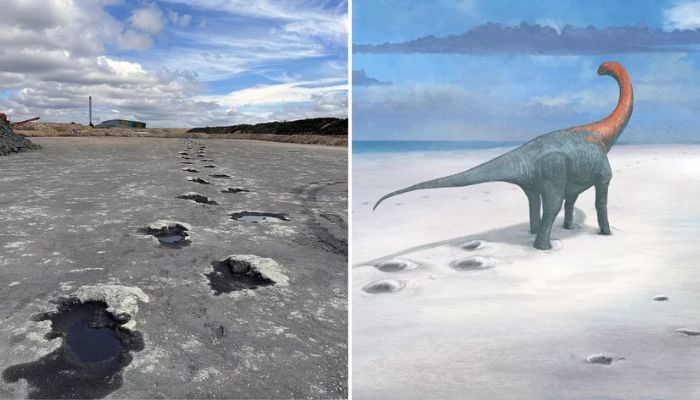
Researchers have announced the discovery of the longest dinosaur trackway in Europe, found at a huge fossil site in an Oxfordshire quarry.
The new finding is part of a massive “dinosaur highway” that provides an extraordinary look back to the Jurassic Period, 166 million years ago.
In the latest round of excavation, led by the University of Oxford and the University of Birmingham, a single trackway made by one gigantic, long-necked dinosaur was documented as spanning an incredible 220 meters (approximately 722 feet) from the first exposed footprint to the last.

This makes it the longest sauropod dinosaur trackway in Europe.
The entire site, located at Dewars Farm Quarry near Bicester, is now considered the largest mapped dinosaur track site in the UK and potentially the largest in the world when combined with earlier finds from the area.
The footprints date back to the Middle Jurassic Period about 166 million years ago.
Two main types of dinosaurs, Sauropods and Megalosaurus, left their prints on what was then a muddy lagoon environment.

Researchers identified several footprints, some up to 1 meter long, with preservation so detailed that they can see how the soft mud was “deformed” as the dinosaur walked.
The tracks sometimes overlap which raises questions about how these huge herbivores and carnivores might have interacted. This site also contained smaller fossils, like a crocodile jaw and marine shells, painting a picture of a tropical coastal environment.
The original discovery was triggered by a quarry worker, Gary Johnson, who noticed “unusual bumps” in the limestone surface while operating his digger. He alerted experts leading to an excavation involving over 100 people.






-
 Will Smith surprises wife Jada Pinkett with unusual gift on Valentine's Day
 -
 James Van Der Beek's friends helped fund ranch purchase before his death at 48
 -
 Brooklyn Beckham hits back at Gordon Ramsay with subtle move over remark on his personal life
 -
 Jennifer Love Hewitt reminisces about workign with Betty White
 -
 Can Sydney Sweeney's brand compete with Kim Kardashian's SKIMS? Expert reveals
 -
 Kim Kardashian, Lewis Hamilton's romance being called a calculated move?
 -
 David, Victoria Beckham melt hearts with sweet Valentine's Day throwbacks
 -
 Valentine’s day on X: New animation rolls out for seasonal mentions