
NASA launches new mission to solve mysteries of solar system's protective shield
IMAP spacecraft will map the heliosphere and study cosmic radiation protection
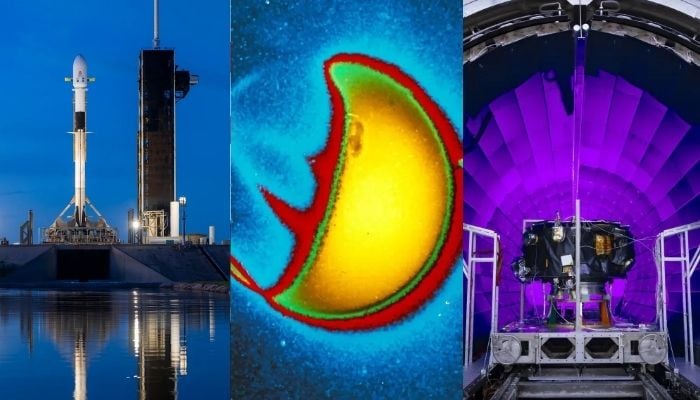
NASA has launched a groundbreaking mission to study the heliosphere, the massive protective bubble surrounding our solar system that shields planets from harmful cosmic radiation and enables life to exist on Earth.
The Interstellar Mapping and Acceleration Probe (IMAP) will provide unprecedented insights into how the sun's solar wind interacts with interstellar space.
The heliosphere, created by a constant flow of charged particles streaming from the sun, extends three times farther than Pluto's orbit and acts as a crucial cosmic shield against the most energetic particles in the universe.
While previous missions like the Voyager probes have provided snapshots of this boundary, IMAP will create detailed maps with 30 times higher resolution than current capabilities.
_updates.jpg)
Dr. David McComas, IMAP's principal investigator at Princeton University: "IMAP is going to make incredibly detailed pictures that will evolve over time in that interaction region.”
McComas further added: “It will be able to understand what the shielding is, how the shielding works and what it looks like."
The spacecraft launched Wednesday, Septmber 24, 2025 alongside two other space weather missions, NASA's Carruthers Geocorona Observatory and NOAA's SWFO-L1, aboard a SpaceX Falcon 9 rocket from Kennedy Space Center.
The trio represents what NASA officials called the ultimate cosmic carpool for studying space weather phenomena that can disrupt communications, navigation systems, and power grids on Earth.
IMAP will orbit approximately 1 million miles from Earth, where it will measure energetic neutral atoms to trace the otherwise invisible boundaries of the heliosphere.
These uncharged particles travel in straight lines unaffected by magnetic fields, allowing scientists to create the most complete map ever of our solar system's protective environment.
The complementary SWFO-L1 mission will serve as an early warning system for solar storms, providing images of solar activity to NOAA's Space Weather Prediction Center within 30 minutes, significantly faster than current eight-hour delays.






-
 Will Smith surprises wife Jada Pinkett with unusual gift on Valentine's Day
 -
 James Van Der Beek's friends helped fund ranch purchase before his death at 48
 -
 Brooklyn Beckham hits back at Gordon Ramsay with subtle move over remark on his personal life
 -
 Jennifer Love Hewitt reminisces about workign with Betty White
 -
 Can Sydney Sweeney's brand compete with Kim Kardashian's SKIMS? Expert reveals
 -
 Kim Kardashian, Lewis Hamilton's romance being called a calculated move?
 -
 David, Victoria Beckham melt hearts with sweet Valentine's Day throwbacks
 -
 Valentine’s day on X: New animation rolls out for seasonal mentions