Trump's hand bruise, makeup spark health concerns: Here's everything you need to know
Recent appearance of bruising, combined with previous instances, sparked health concerns, particularly his age and previous struggles with Chronic Venous Insufficiency (CVI)

United States (U.S.) President Donald trump was spotted with bruising on the back of his right hand again on Monday, August 25, 2025, in the Oval Office, during a meeting with the South Korean President Lee Jae Myung.
This recent appearance of bruising, combined with previous instances where he used makeup to cover similar marks, has sparked concerns about his health, particularly given his age and previous struggles with Chronic Venous Insufficiency (CVI).
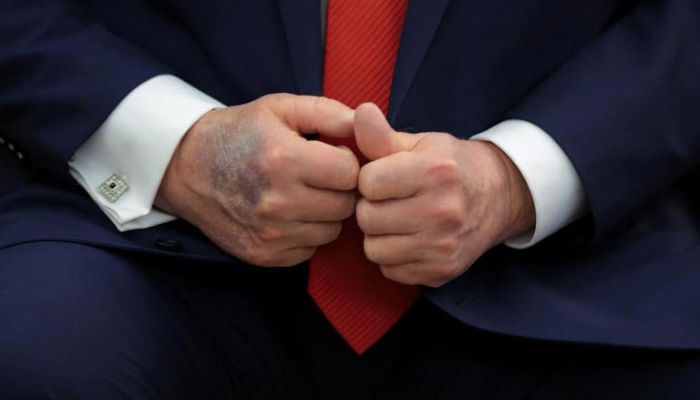
This recent appearance of bruising, combined with previous instances where he used makeup to cover similar marks, has sparked concerns about his health, particularly given his age (79) and previous struggles with chronic venous insufficiency.

Over the weekend, Trump was photographed with a smaller bruise on his left hand, days after he was seen with a thick layer of makeup on the back of his right hand while visiting the People’s House Museum in Washington.
The white house initially blamed the bruising on hand shaking, echoing Trump, who gave Times the same reason for the apparent injury during interview in December, telling the magazine, “It’s from shaking hands with thousands of people.”
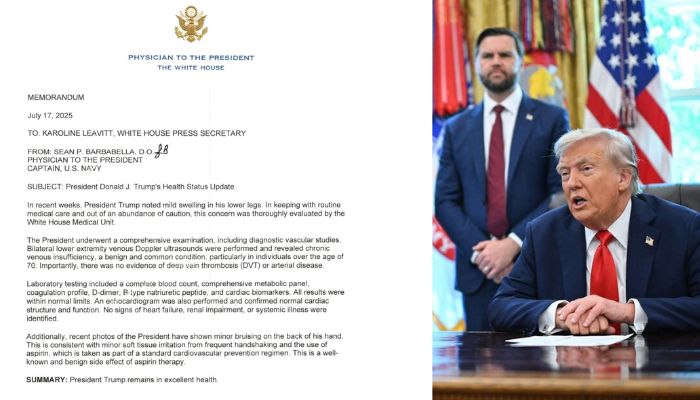
Elaborating on the bruising in July, the white House released a letter from the president’s physician, Sean Barbabella, stating the bruising “is consistent with minor soft tissue irritation from frequent handshaking and the use of aspirin, which is taken as part of a standard cardiovascular prevention regimen”.
What did the letter reveal about Donald Trump?
The letter revealed Trump was diagnosed with chronic venous insufficiency, what Barbabella said is a “benign and common condition, particularly in individuals over the age of 70,” but testing showed “there was no evidence of deep vein thrombosis (DVT) or arterial disease.”
What’s Chronic Venous insufficiency (CVI)?
Chronic venous insufficiency (CVI) happens when your leg veins become damaged and can’t work as they should. Normally, valves in your leg veins keep blood flowing back up to your heart.
But, CVI damages those valves, causing blood to pool in your legs. This increases pressure in your leg veins and causes symptoms like swelling and ulcers, according to the Cleveland Clinic.
What causes chronic venous insufficiency?
Most cases of CVI are due to genetics, but certain risk factors can increase a person’s chance of developing the condition.
These risk factors include a history of deep vein thrombosis, varicose veins or a family history of varicose veins, obesity, smoking and tobacco use and sitting or standing for long periods.
However, the chance of developing the condition also increases with age. Trump celebrated his 79th birthday on June 14.
He is the second oldest person to serve as President of the United States and the oldest to begin a term as president.


-
 Destiny 2 development ends after nearly a decade of updates
 -
 'Virgin River' star found dead days after going missing: Here's what we know
 -
 'It Takes Two' rapper Rob Base passes away at 59
 -
 Dustin Hoffman sets clear boundaries at 88: 'I can't look'
 -
 Stephen Colbert gushes over his wife Evelyn McGee Colbert
 -
 Trump confirms he will not attend son Donald Trump Jr.'s wedding with Bettina Anderson
 -
 How did Kyle Busch die? Leg injury and lawsuit draw attention as fans mourn his death
 -
 Sora shutdown forces AI film Critterz to miss Cannes