Rare Blood Moon to grace UAE skies on September 7: What's special about it?
Dubai Astronomy Group share timings and explains why you can't miss this lunar eclipse
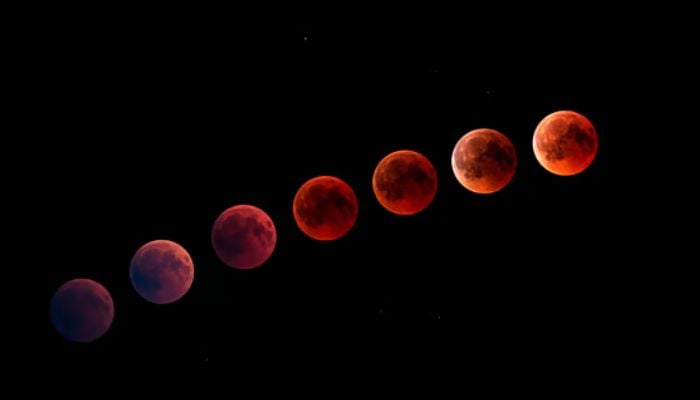
The total lunar eclipse, popularly known as blood moon, is all set to illuminate the skies in the UAE on September 7, 2025, continuing into the early hours of September 8 marking one of the most enthralling celestial events of the decade.
The total phase of the eclipse will last a remarkable 82 minutes, making it one of the longest lunar eclipses in recent history.
Where can you watch it?
Stargazers in the UAE will enjoy nearly five and a half hours of eclipse viewing.
- 7.28 p.m.-Penumbral eclipse begins
- 8.27 p.m.-Partial eclipse begins
- 9.30 p.m.-Total eclipse begins
- 10.12 p.m.-Maximum eclipse
- 10:53 p.m.-Total eclipse ends
- 11.56 p.m.-Partial eclipse ends
- 12.55 a.m. (Sep 8)-Penumbral eclipse end
How to get the best view of Lunar Eclipse?
The eclipse is safe to view with the naked eye and particularly requires no special lens.
The Dubai Astronomy Group (DAG) has recommended using telescopes or binoculars for capturing stunning lunar spectacle. However, for astronomical enthusiasts, and having the best viewing experience, a tripod-equipped camera can be used for capturing memorable experiences.
It is suggested to choose a location away from bright city lights to avoid any sort of visual interference.
Blood Moon
There is a significant reason behind the total lunar eclipse turning red.
According to the Operations Manager at DAG Khadijah Al Harir, “The moon will be turning red as the Earth passes directly between the sun and the moon, casting a shadow across the lunar surface.”
Primarily, when the eclipse enters the total stage, the moon is fully immersed in the “umbra’’- this is the region of complete shadow, where all sunlight is cut off.
The moon’s red glow prime reason comes from “sunlight that has been filtered and bent through Earth’s atmosphere,” confirmed by DAG.
It will be scattering shorter, blue wavelengths away, and ultimately allowing the larger orange and red wavelengths to reach the moon. This will create a Blood Moon, allowing residents to see a remarkable view of the moon turning beautiful red in the sky.
Four phases of the eclipse
Have a look into the distinct features of each eclipse phase:
Penumbral phase
It is the first stage when the moon enters the outer part of Earth’s shadow, the moon will start dimming which may be hard to detect with the naked eye.
Partial phase
It is the second phase when the moon moves into umbra and a noticeable “bite” appears on the lunar surface.
Totality
It is the most intriguing part as the moon is fully inside the umbra. This is where it turns red, orange or copper depending upon the Earth’s atmospheric conditions.
Ending phases
The Moon gradually moves out of the umbra and penumbra reversing the process.
Next eclipses
Residents of the UAE will experience the next visible lunar eclipse on July 6, 2028. It will be a partial eclipse, and a unique celestial will occur, when a total lunar eclipse will beacon New Year Eve on December 31, 2028.


-
 How did Brandon Clarke die?
 -
 Taylor Swift wins BMI Songwriter crown for third year in a row
 -
 Katseye announces world tour, sending internet into meltdown
 -
 Pete Davidson urged not to target Charlie Kirk in comedy set: Insider
 -
 Chyler Leigh, Nathan West call it quits after 24 years of marriage
 -
 Watch Kanye West's reaction to Pete Davidson's savage roast jab
 -
 Eileen Wang: Who is Democratic Party's mayor of Arcadia ?
 -
 Savannah Guthrie finally shares 'something joyful'