Inside Hamas's secret 'mini army' built to fight Israel
Hamas launched more than 2,500 rockets during the attack on October 7, which was the worst breach in Israel's defences in 50 years
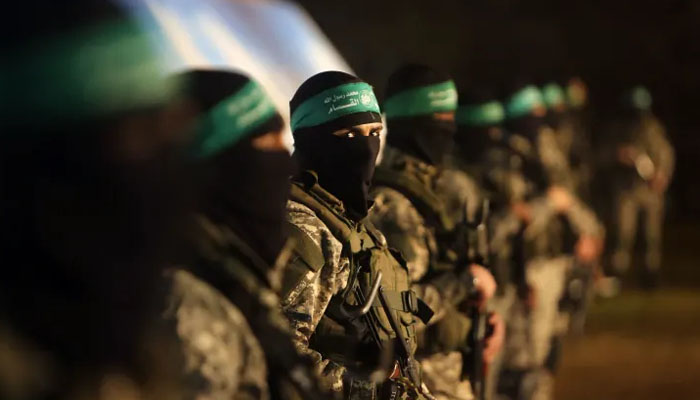
Israeli forces preparing to enter Gaza on a mission to destroy Hamas would face an increasingly capable adversary that has been secretly supported by a network that extends far beyond the small enclave to Iran and other Arab parties for years.
Six days ago, Hamas launched a murderous strike on southern Israel that was unparalleled for the organisation in terms of strategy and scope. The attack was a devastating illustration of the military prowess the organisation has developed since seizing control of Gaza in 2007.
"Necessity is the mother of invention," said Ali Baraka, a senior Hamas official, adding that the group had long drawn on money and training from Iran and Iranian regional proxies like Lebanon's Hezbollah while bolstering its own forces in Gaza.
Since it has been difficult to import guns, according to Baraka, a Lebanese citizen, "we developed our capabilities and are able to manufacture locally" over the previous nine years.
Hamas rockets had a maximum range of 40 km (25 miles) in the 2008 Gaza War, but by the 2021 Conflict, that range had increased to 230 km.
According to Reuters interviews with 11 people familiar with the group's capabilities, including Hamas figures, regional security officials, and military experts, the secretive and sprawling organisation is unrecognisable from the small Palestinian group that issued its first leaflet protesting Israeli occupation 36 years ago.
"They are a mini-army," said a source close to Hamas in the Gaza Strip, who declined to be named due to the sensitivity of the matter. He said the group had a military academy training a range of specialisations including cyber security and boasts a naval commando unit among its 40,000-strong military wing.
According to the website globalsecurity.org, Hamas had less than 10,000 fighters in the 1990s.
According to a regional security source who also declined to be identified, the group has been creating a network of tunnels under Gaza since the early 2000s to aid in fighter dispersal, house weapons facilities, and bring in weaponry from abroad.
According to Hamas authorities, the group has obtained a variety of bombs, mortars, rockets, anti-tank, and anti-aircraft missiles.
Over time, the growing capabilities have led to progressively destructive outcomes. During its 2008 invasion, Israel lost nine troops. The number increased to 66 in 2014.
Israel is anticipated to strike the heavily populated enclave, and H.A. Hellyer, a senior associate fellow at Britain's Royal United Services Institute, claimed that it was capable of destroying Hamas.
"The question isn't whether it's possible or not. The question is what sort of price will be exacted on the rest of the population because Hamas does not live on an island in the ocean or in a cave in the desert."
According to the US-based non-profit Jewish Institute for National Security of America, after the most recent Gaza war in 2021, Hamas and an affiliated group known as Palestinian Islamic Jihad managed to keep 40% of their missile inventories, a key target of the Israelis, keeping roughly 11,750 missiles as opposed to 23,000 before the conflict.
Israel, the US, the EU, Canada, Egypt, and Japan all classify Hamas as a terrorist organisation because its founding charter from 1988 called for the eradication of Israel.
According to Western authorities, Hamas has assisted Iran in realising its long-held goal of encircling Israel with hordes of paramilitaries, including other Palestinian factions and Lebanon's Hezbollah.
All are armed with cutting-edge weapons and have long been hostile to Israel's occupation of Palestinian territory.
Although the group's power base is still in Gaza, its commanders are dispersed around the Middle East in places like Qatar and Lebanon. In advance of the anticipated ground assault that will follow days of Israeli bombardment that have killed over 1,800 Palestinians, it has urged Gazans not to accept Israel's demand to leave.
Hamas launched more than 2,500 rockets during the attack on October 7, which was the worst breach in Israel's defences in 50 years. Fighters using paragliders, motorbikes, and four-wheel drive vehicles overpowered Israeli forces and tore through towns and communities, murdering 1,300 people and kidnapping scores of others.
According to the sources Reuters spoke with, despite Iran funding, arming, and training the group, there was no proof that Tehran was responsible for planning or approving the attack on October 7.
"The decision, zero-hour, all of that was in Hamas' hands – but of course, the general cooperation, training and preparation all came from Iran," said the regional security source.
Iran acknowledges supporting and educating Hamas, but it denies any involvement in the attack, despite having hailed it.
Hamas leader Ismail Haniyeh said in an interview with Al Jazeera television last year that his group had received $70 million in military help from Iran. "We have rockets that are locally manufactured but the long-range rockets came from abroad, from Iran, Syria and others through Egypt," he added.
Approximately $100 million is given annually by Iran to Palestinian organisations like Hamas, Palestinian Islamic Jihad, and the Popular Front for the Liberation of Palestine-General Command, according to a 2020 report from the US State Department.
According to a security source in Israel, Iran dramatically upped its yearly contribution to Hamas's military wing from $100 million to roughly $350 million over the past year.
On December 10, 1987, some Muslim Brotherhood members met the day after an Israeli army truck collided with a car carrying four Palestinian day labourers, killing all of them. This is when the idea for Hamas, which means enthusiasm in Arabic, first emerged. Following were protests with stone-throwing, strikes, and closures in Gaza.
They decided to publish a pamphlet on December 14 calling for resistance as the First Intifada, or revolt, against Israel, began after meeting at the home of Muslim cleric Sheikh Ahmed Yassin. It was their first public performance as a unit.
According to Western intelligence sources, Hamas started importing rockets, explosives, and other materials from Iran after Israel withdrew from Gaza in 2005. They stated that they were smuggled into Gaza through a maze of tiny tunnels beneath the Sinai Peninsula after being trucked across Egypt and delivered via Sudan.
Other regional paramilitary partners also received supplies of weaponry, training, and money from Iran, which finally gave Tehran a dominant presence in Lebanon, Syria, Iraq, Yemen, and Gaza.
Some of these friends are connected by a "Shi'ite axis" that includes Shi'ite paramilitaries in Iraq, Hezbollah in Lebanon, and the Alawite minority, which rules Syria and is a branch of Shi'ite Islam.
Hezbollah, which was created at the Iranian embassy in Damascus in 1982 when Israel invaded Lebanon during the 1975–1990 civil war, is the crown jewel of Iran's militia network.
In 2000, Hezbollah forced Israel out of Lebanon by bombing American targets and pursuing a hostage-taking and hijacking strategy. Since then, it has steadily taken control of key state institutions in Lebanon.
Iran seized the opportunity to co-opt Hamas in 1992 when Israel deported about 400 Hamas leaders to Lebanon, a source close to Hamas said. Iran and Hezbollah hosted Hamas members, shared military technology and trained them in building homemade bombs for suicide attacks, the person added.
The ultimate goal of the attack on Israel on October 7 was to win the release of all 5,000 Palestinian prisoners detained in Israeli jails, put an end to Israeli incursions on the Al Aqsa mosque, the third holiest site in Islam, and relieve a 16-year-old blockade of Gaza, according to Hamas spokesman Baraka.
He stated that if Israel's ground offensive, which was supported by the United States and Great Britain, went forward, the war would not be limited to Gaza and might instead spread to other parts of the area.
"It's not just an Israeli war on Gaza, there is an Atlantic war on Gaza with all the powers," he said. "There will be new frontlines."


-
 Chris Nanos mocked for Halloween video as Nancy Guthrie remains missing
-
 Driver released after deadly Wichita soccer crash leaves two dead and 10 injured
-
 Andy Burnham targets 'headphone dodgers' with new £100 bus fines
-
 Amazon deforestation drops to lowest level since 1988 as Brazil election looms
-
 Alberta separation unlikely as new poll reveals strong support for staying in Canada
-
 Obama says Ilhan Omar deportation threat could set dangerous precedent for Americans
-
 Four Canadian soldiers killed in Wainwright fire as Mark Carney orders flags lowered
-
 Macron empowers local authorities to ban gatherings amid protests
-
 Trump reacts to violent unrest in France, blames immigration
-
EU condemns West Bank settler attacks targeting European diplomats
-
France protests turn violent: Over 1,800 arrested amid nationwide clashes and looting as riots devastate Paris streets
-
Pope Leo outlines major gradual return to duties in first event since cancer surgery