
IT ministry presents ‘National Cyber Security Policy-2021’ in NA
NCSP gives framework for effective implementation of cyber security measures that would result in enhancing cyber defence capabilities
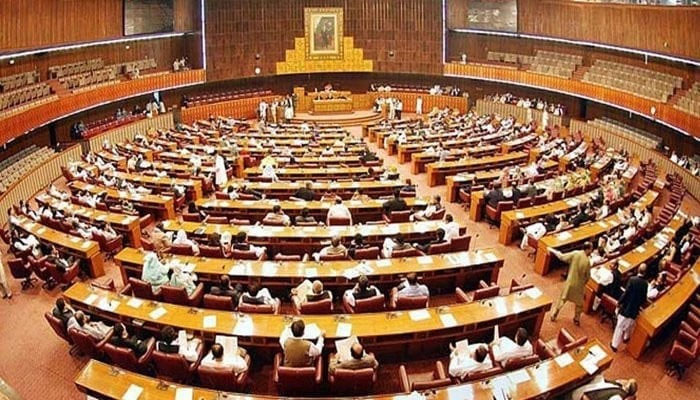
ISLAMABAD: The Ministry of Information Technology and Telecommunications has presented the “National Cyber Security Policy-2021 (NCSP)” in the National Assembly that envisages Pakistan to have a secure, robust, and continually improving nationwide digital ecosystem ensuring confidentiality, integrity, and availability of digital assets leading to socio-economic development and national security.The IT ministry presented the NCSP in the NA to a question of Syed Shehla Raza who asked as to what measures being taken by the government for strengthening the country’s cyber defence capabilities, adding the ministry should ensure that cyber security policies align with international best practices.
According to the NCSP presented by the IT ministry in light of the “Digital Pakistan Policy 2018”, “Pakistan to have a secure, robust, and continually improving nationwide digital ecosystem ensuring confidentiality, integrity, and availability of digital assets leading to socio-economic development and national security.
“The NCSP gives a framework for effective implementation of cyber security measures that would result in enhancing the cyber defence capabilities.
“An institutional ecosystem is one of the most important pillars for implementing cybersecurity measures.” The NCSP-2021 envisioned an institutional ecosystem i.e. computer emergency response teams (CERTS), based on three tier approach/levels i.e. (1) national; (2) sectoral; (3) organisational/enterprise.
The CERTs are responsible for the protection against, detection of, and response to cybersecurity incidents, and will enhance the country’s ability to manage cyber security incidents.
Further, the NCSP focuses on 10 key areas to enhance national cyber defence capabilities, such as institutional framework; protection & information sharing; infrastructure; audit & compliance; integrity of ICT products (screening); trust in digital transitions; capacity building; indigenisation/R&D; prevention of cyber crimes; international collaborations.
The IT ministry formulated the CERT Rules in consultation with the concerned stakeholders which were approved by the federal cabinet in 2023.
Under the given policy, a “cloud office” has been established at the IT ministry, whereas other frameworks like procurement and cloud service provider accreditation criteria have been published, that also includes the categorisation of service providers as per mandatory “cloud security requirements”.
Big players from the IT & telecom industry have already shown keen interest in investing and raising cloud-based infrastructures. The draft for Personal Data Protection Bill, is in its final round of consultation with stakeholders.
The Bill lays out the modus operandi and ancillary details for the usage of sensitive data such as its processing, collection, storage, and disclosure by government, organisations, and individuals for processing purposes.
The Bill provides for data protection mechanisms including the offences concerning the violation of the data privacy rights of an individual.
The Bill ensures an environment of fair practices in the digital economy by offering legal protections to online transactions and the sharing of personal and sensitive information or data for personal, international e-commerce, and e-government services.
Separately, the Establishment Division presented a report in the National Assembly with regard to e-quota reserved for Balochistan under the federal recruitment policy.
The report was presented in reply to a question of Jamal Shah Kakar, who asked as to whether the Establishment Division has taken notice of the fact that the quota reserved for Balochistan under the federal recruitment policy was not being implemented by various departments in letter and spirit.
In reply, the Establishment Division stated that it has persistently been drawing the attention of all the ministries / divisions to give priority to the process of filling up vacant posts against Balochistan quota.
It said all the ministries/ divisions/ departments have assured the Establishment Division for the implementation of the constitutional quota in letter and spirit, adding the Establishment Division has issued directions to ministries/ divisions to implement 6 per cent Balochistan quota adopting prescribed strategy.


