
COVID-19 nasal swab test punctures woman's brain lining causing fluid leak
"It underscores the necessity of adequate training of those performing the test and the need for vigilance after the test has been performed," says a researcher
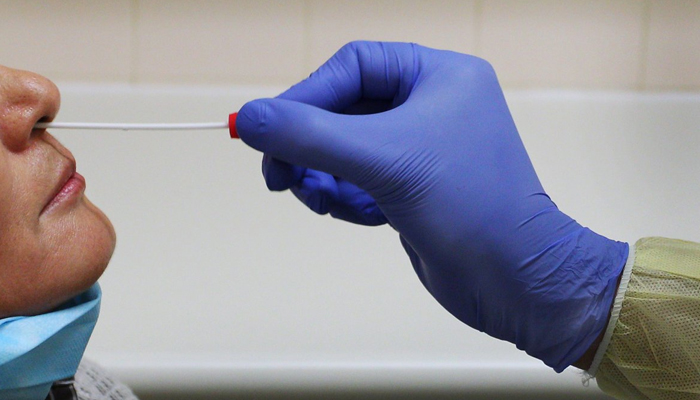
WASHINGTON: Doctors, in a medical journal, said Thursday that a COVID-19 nasal swab test punctured a US woman's brain lining, causing fluid to leak from her nose and putting her at risk of life-threatening infection.
The patient, who is in her 40s, had an undiagnosed rare condition and the test she received may have been carried out improperly, a sequence of improbable events that means the risk from nasal tests remains very low.
But her case showed health care professionals should take care to follow testing protocols closely, Jarrett Walsh, senior author of the paper that appeared in JAMA Otolaryngology-Head & Neck Surgery, told AFP.
People who've had extensive sinus or skull base surgery should consider requesting oral testing if available, he added.
"It underscores the necessity of adequate training of those performing the test and the need for vigilance after the test has been performed," added ear, nose and throat specialist Dennis Kraus of Lenox Hill Hospital in New York, who wasn't involved in the paper.
Walsh, who practices at the University of Iowa Hospital, said the woman had gone for a nasal test ahead of an elective hernia surgery, and afterward noticed clear fluid coming out of one side of her nose.
She subsequently developed headache, vomiting, neck stiffness, and aversion to light, and was transferred to Walsh's care.
"She had been swabbed previously for another procedure, same side, no problems at all. She feels like maybe the second swab was not using the best technique, and that the entry was a little bit high," he said.
In fact, the woman had been treated years earlier for intracranial hypertension — meaning that the pressure from cerebrospinal fluid that protects and nourishes the brain was too high.
Doctors at the time used a shunt to drain some of the fluid and the condition resolved.
But it caused her to develop what's called an encephalocele, or a defect at the base of the skull which made the brain's lining protrude into the nose where it was susceptible to rupture.
This went unnoticed until old scans were reviewed by her new doctors, who carried out surgery to repair the defect in July.
She has since fully recovered.
Walsh said he believes the symptoms she developed were a result of irritation to the lining of the brain.
If the problem hadn't been treated, she could have developed a potentially life-threatening brain infection from bacteria that traveled up the nose.
Or, air could have entered the skull and placed excess pressure on the brain.
Most testing protocols call for clinicians to follow the path of the floor of the nose, which lies above the roof of the mouth, rather than pointing the swab up — or if they point it up, to do so with great care.
Walsh said that though this was likely a very rare occurrence, it was a reminder of the need for high-quality training, given that hundreds of millions more tests will be performed before the pandemic is over.





-
 Lenore Taylor resigns as Guardian Australia editor after decade-long tenure
 -
 Epstein case: Ghislaine Maxwell invokes Fifth, refuses to testify before US Congress
 -
 Savannah Guthrie receives massive support from Reese Witherspoon, Jennifer Garner after desperate plea
 -
 Trump nears 500 press interactions in his second term, surpassing former President Biden
 -
 Snow forecast warns of reduced visibility and travel risks in Ontario
 -
 Casey Wasserman says he ‘deeply regrets’ Ghislaine Maxwell emails after DOJ file release
 -
 Gordie Howe Bridge faces uncertainty after Trump warning to Canada
 -
 Air Canada’s flights to Cuba halted as aviation fuel crisis worsens