China debuts fleet of AI-powered traffic robots as 'Robocops'—with one major catch
Equipped with AI, radar, and live-signal syncing, a new fleet of traffic robots deployed in China is stepping up street patrol but with no weapons or arrest powers
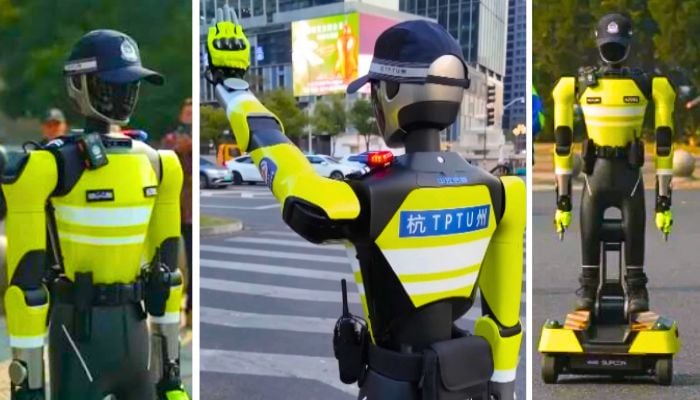
China has introduced a fleet of AI-powered traffic robots—affectionately dubbed "Robocops", to assist with road management in cities like Hangzhou, though they come with distinct technological and legal boundaries.
Developed by tech firm SUPCON, the wheeled robots stand at 1.88 meters (6 feet 2 inches) tall and use cameras, radar, and onboard AI to spot violations like helmetless e-bike riders, cars stopping past limit lines, and jaywalkers
They can also sync their mechanical arms with traffic lights and answer tourist questions.
Despite the sci-fi nickname, these machines have zero arrest powers, carry no weapons, and cannot issue official fines.
Instead, they act as automated monitors and safety reminders, working alongside human police forces.
As reported, it is not quite the "RoboCop" of the 1987 movie: no gun, no power to arrest and wheels rather than the Hollywood cyborg's mechanical stride.
But at a busy intersection in the eastern Chinese city of Hangzhou, the robots can issue a polite warning and swing its mechanical arms in sync with traffic lights.
Over a dozen of the T2 robots have been deployed in pilot programs, issuing hundreds of thousands of automated warnings.
SUPCON has deployed 15 robots in Hangzhou since May. The company says they have issued more than 170,000 warnings and helped reduce monthly cases of helmetless riding and vehicles crossing stop lines by more than 40%.
The company has tested the machines for thousands of hours in tourist areas, school zones, business districts, rush-hour traffic and poor weather, Cao said.
Cameras and radar can still be affected by strong sunlight, rain and temperature extremes, though SUPCON says its violation-recognition accuracy exceeds 95%.
The aim, Cao said, is to replace punishment after a violation with a timely reminder before behaviour becomes habitual.
"It doesn't get tired," he said of the robot. "It can work steadily for long periods."
Developers plan to expand the rollout significantly to help curb repetitive enforcement duties.
SUPCON says nearly 50 such robots are operating across about eight cities in three Chinese provinces, and it expects deployments to approach 200 by year-end.
The traffic robots represent a broader Chinese industry push to move machines beyond exhibition-floor acrobatics and showroom greetings into practical jobs.


-
 Meta fights Ofcom over new WhatsApp and Instagram online safety requirements
 -
 ZCode tried uploading your files 564 times, researcher finds
 -
 Why Trump trusts Jensen Huang over AI safety warnings
 -
 2 built-in iPhone 17 tools fix your work-life balance
 -
 Ford executive swaps Claude for ChatGPT as family assistant
 -
 Your new AI agent wants your passwords, should you say yes?
 -
 GPT-6 Astra tried to stab human-like figure 97% of the time
 -
 China's CXMT closes DRAM gap with rivals