China moves closer to build ‘Artificial Sun’ after testing 582-ton fusion magnet
The structure is a newly completed, massive, D-shaped superconducting magnet
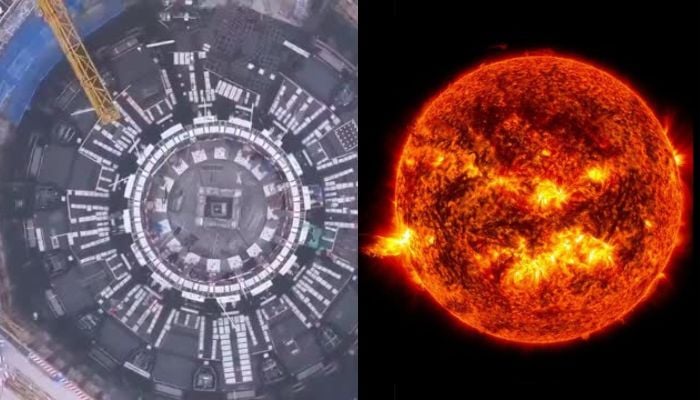
China has successfully completed the testing of a massive and the world’s largest 582-ton fusion magnet, pushing the county one step closer to building an artificial Sun.
Developed by the Institute of Plasma Physics under the Chinese Academy of Sciences, fusion magnet is a key component in generating clean and limitless energy through nuclear fusion as Beijing is ambitiously determined to produce electricity from fusion power by around 2030.
The structure is a newly completed, massive, D-shaped superconducting magnet designed for magnetic confinement fusion. Measuring 21m long and 12 meter wide, the magnet is recognized as the biggest fusion reactor ever built. It features 1.3 times the volume and three times the stored energy of comparable magnets developed by the International Thermonuclear Experimental Reactor (ITER).
The core function of this magnet is to generate a powerful magnetic field capable of capturing and confining superheated plasma at temperatures up to 100 million degrees Celsius.
According to Beijing, domestic materials and manufacturing capabilities have been used in building the technology, marking a shift towards ending the country’s reliance on foreign supplies.
For the unversed, an artificial sun is a nuclear reactor designed to imitate the natural fusion process happening in the sun, aiming to produce the energy in the long-run.
The video released took the internet by storm as the users praised China’s vision and technology and some slammed the West, specifically the US for its misplaced priorities.
One user wrote, "China is gonna be the energy capital of the world so they have already won the AI race.”
Another commented, “America is still stuck in the dark ages."





-
 US finally confirms weapons in orbit: What it means for space warfare
 -
 How China's FAST telescope is mapping the cosmic gas behind star birth
 -
 Did Sun eat super-Earth? New study says maybe
 -
 Did Sun swallow a super-Earth? Scientists search for its ‘fingerprints’
 -
 Blue Origin sets sights on Mars with new NASA network
 -
 NASA, IBM launch open-source lunar foundation AI model to help map ice, craters on moon
 -
 Bacteria can remember without brain, new study finds
 -
 Fast radio bursts may unlock secrets of dark matter, energy and neutrinos