Tiny-ring style mouse lets you control your computer with your finger
Lightweight computer mouse that you can wear on your finger like a ring
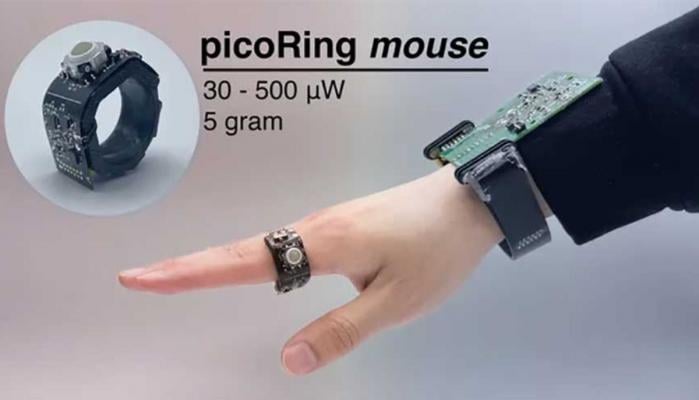
Researchers have made a ground-breaking discovery of a light-weight computer mouse, which offers an alternative method of controlling a computer cursor and works for more than a month on a single charge.
It is commonly called picoRing; the device weighs just 0.18 ounces (5grams) and is specifically designed as a subtle and restrained alternative to traditional mice.
Meanwhile, its inventors observe it as a contender for controlling augmented reality (AR) and virtual reality (VR) systems, where compact, hands-free control provides a tangible benefit over standard input devices.
Users can scroll and interact with logical interfaces using small hand gestures, making picoRing ideal for setups that lack desk space.
The researchers declared in a statement that because the ring sits in direct contact with skin, future versions would allow them to monitor heart rate, stress levels and other health markers.
While the combination of these health features with interaction control could open new ways to “multifunctional wearable devices”, this technology is still in the prototype phase.
In this connection, assistant professor at the University of Tokyo’s Department of Electrical Engineering and Information Systems, Ryo Takahashi, said in an official statement, “Although it’s just a prototype, picoRing could have several useful impacts on the way people interact with technology."
The humble computer mouse has been in use for almost 60 years, and although its design has been improved in that time, attempts to revolutionize it have never quite taken hold.
Researchers hope that picoRing’s practical redesign and long-lasting battery will help it stand out and gain momentum, particularly ring-shaped wearables.
Nevertheless, this computer mouse represents a remarkable step forward, ultimately providing flexibility from the desk to the user’s hand.
In contrast, small rings suffer from short lifespans because of their tiny batteries.
However, picoRing only uses hundreds of times less power at around 30-500 microwatts, which is hundreds of times less power, mitigating this challenge.






-
 EasyJet agrees to accept a surprise takeover bid from a rival US firm: Here’s why
 -
 Could SpaceX outvalue all of Earth? Elon Musk thinks so—here’s why
 -
 Trump updates Netanyahu on major US Gulf strategy after renewed Iran strikes
 -
 Indonesian farmer goes viral for riding a drone to work
 -
 Call of Duty: Black Ops 1 and 2 hit PS5, prices revealed
 -
 Elon Musk changes tune on Anthropic, calls it ‘leader in AI’
 -
 Zuckerberg breaks 3-year silence on 'X' with surprise return
 -
 Epstein lawyer’s first death anniversary approaches months after DOJ files rocked the world