Scientists made unusual discovery about 3I/ATLAS in new study
A strange phenomenon is observed by astronomers which further deepens mystery about interstellar object’s nature
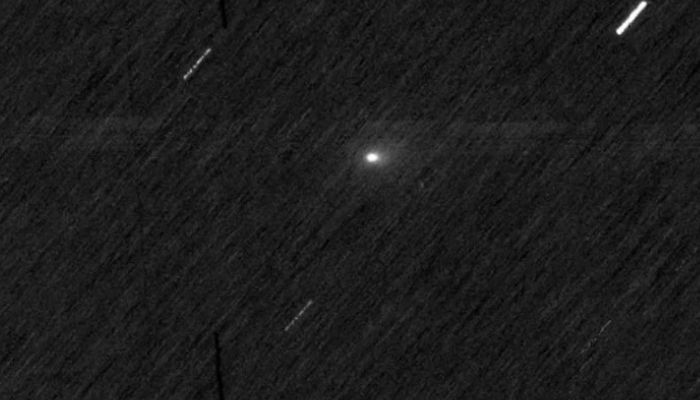
Mysterious interstellar object 3I/ATLAS which is racing through our solar system, has once again baffled scientists with its unusual behaviour in a new study.
Scientists for the very first time have detected that 3I/ATLAS is gushing water like a “fire hose running at full blast” by using NASA’s Neil Gehrels Swift Observatory.
Assessing the chemical fingerprint of water spilling from an interstellar comet may offer insights into the true nature of the 3I/ATLAS which was first detected in July.
Water is considered a benchmark in understanding comet science. The leaking of water will allow astronomers to compare 3I/ATLAS directly with other comets present in the solar system, offering a glimpse into the chemical composition of distant planetary objects.
Dennis Bodewits, study co-author and professor of physics at Auburn University said, "When we detect water — or even its faint ultraviolet echo, OH — from an interstellar comet, we're reading a note from another planetary system. It tells us that the ingredients for life's chemistry are not unique to our own."
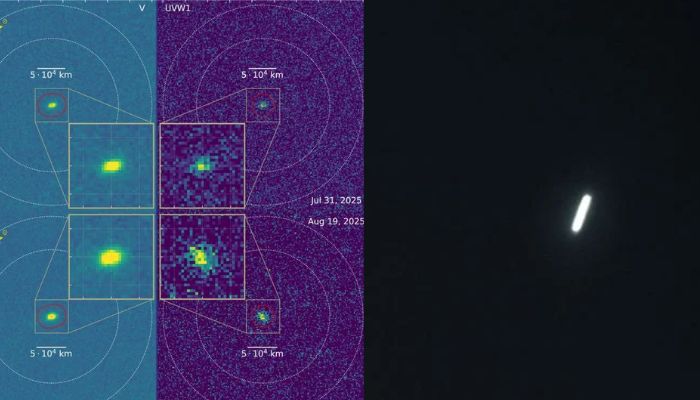
Bodewit and his team used the Swift telescope to observe 3I/ATLAS in July and August 2025 when it was at a distance of about 2.9 times farther from the sun than Earth.
The team first observed the dim ultraviolet glow of OH (hydroxyl), which is the product when water molecules break in the presence of sunlight.
The findings published in the journal Astrophysical Journal Letters proved that the 3I/ATLAS was leaking water at record speed of roughly 40 kilograms per second, or “roughly the output of a fire hose running at full blast."
Based on the rate of water outflow, researchers estimated that at least 8 percent of the interstellar object’s surface must be active, showing a surprising departure from the other comets that exhibit 3-5 percent active surface activity.
Zexi Xing, a postdoctoral researcher at Auburn University in Alabama who led the new study, issued a statement, “Every interstellar comet so far has been a surprise. Oumuamua was dry, Borisov was rich in carbon monoxide.”
“Now ATLAS is giving up water at a distance where we didn't expect it. Each one is rewriting what we thought we knew about how planets and comets form around stars," Zexi added.
NASA and ESA have recently released the images of 3I/ATLAS when it was racing past the Martian planet, giving insights into the origin of the object.


-
 Jennifer Eckhart, former Fox News producer, dies at 36
 -
 Pope Leo urges tech leaders to build AI systems that unite rather than devide
 -
 Will Taylor Swift attend 2026 MTV VMAs to receive new Artist Director award?
 -
 Prince Harry to tell Princess Diana's story again in new documentary?
 -
 Presley Gerber death: Drug overdose emerges as suspected cause
 -
 Brad Pitt is back as Cliff Booth in ‘The Further Mis-Adventures of Cliff Booth’
 -
 Kit Harington wanted 'Harry Potter' TV series before joining the cast
 -
 Halle Berry eyes future role with ‘sweetest’ Zendaya