ESA’s ExoMars catches glimpse of 3I/ATLAS racing past Martian planet
Interstellar object 3I/ATLAS arrived within a distance of 30 million kilometers from Mars
European Space Agency (ESA) has recently released the new images of interstellar object 3I/ATLAS taken by ExoMars Trace Gas Orbiter (TGO)
The new image came on the heels of pictures taken by NASA Perseverance Rover which showed the object as a large cylindrical stripe, emitting the green color.
In new snaps captured by ESA through its Colour and Stereo Surface Imaging System (CaSSIS), the interstellar object appears to be a tiny and blurry white dot.
At 30 million kilometers distance from the Mars, the nucleus diameter of 3I/ATLAS is much smaller, ranging from 5km to 46 km.
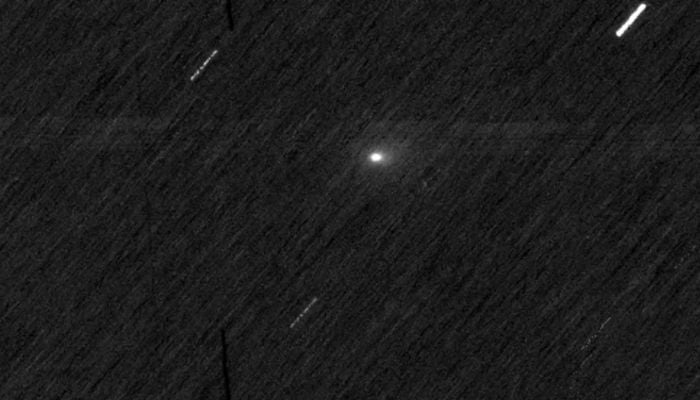
Harvard astrophysicist Avi Loeb has made an analysis by interpreting the images released by ESA. According to him, the bright glow around 3I/ATLAS in the CaSSIS image was measured to be 68 kilometers wide.
According to Loeb, the projected 680 km width is an order of magnitude smaller than 4000 kilometers, previously observed through the Hubble Space telescope which showed the object as a bright ball of light.
In the series of images, the object’s icy nucleus and its surrounding halo of dust and gas could not be distinguished properly.
CaSSIS only detected the glowing inner region of the surrounding gas and dust envelope outside nucleus.
CaSSIS Principal Investigator Nick Thomas said in a statement released by ESA on Tuesday, “This was a very challenging observation for the instrument. The comet is around 10,000 to 100,000 times fainter than our usual target."
While talking about the true origin of the interstellar object, ESA officials said, "Every planet, moon, asteroid, comet and lifeform in our solar system share a common origin. But interstellar comets are true outsiders, carrying clues about the formation of worlds far beyond our own."
3I/ATLAS was first spotted in July by the Asteroid Terrestrial-impact Last Alert System (ATLAS) telescope in Río Hurtado, Chile. It is the third interstellar object which is detected after 1I/Oumuamua in 2017 and 2I/Borisov in 2019.
Could 3I/ATLAS really hit Earth?
The trajectory of the interstellar object has brought 3i/ATLAS closer to the planets, including Venus, Mars, and Jupiter, but not Earth, thereby posing no threat to Earth.


-
 Jennifer Eckhart, former Fox News producer, dies at 36
 -
 Pope Leo urges tech leaders to build AI systems that unite rather than devide
 -
 Will Taylor Swift attend 2026 MTV VMAs to receive new Artist Director award?
 -
 Prince Harry to tell Princess Diana's story again in new documentary?
 -
 Presley Gerber death: Drug overdose emerges as suspected cause
 -
 Brad Pitt is back as Cliff Booth in ‘The Further Mis-Adventures of Cliff Booth’
 -
 Kit Harington wanted 'Harry Potter' TV series before joining the cast
 -
 Halle Berry eyes future role with ‘sweetest’ Zendaya