Two new comets streak across night sky in rare celestial display
Comets Lemmon and SWAN make closest approaches to Earth this month, offering limited viewing window before vanishing for centuries
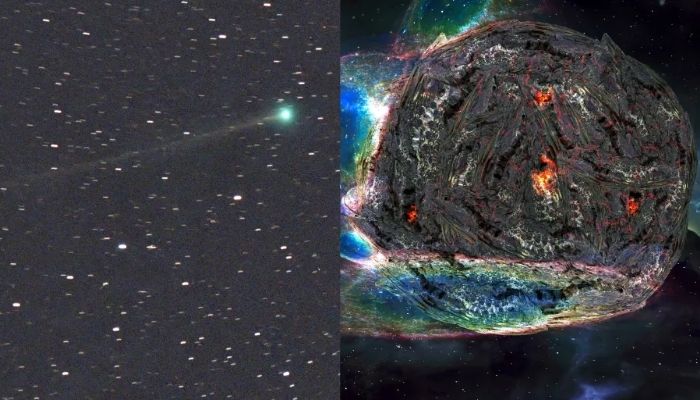
Comet C/2025 A6 Lemmon and Comet C/2025 R2 SWAN are making their closest approaches to Earth this month, offering skywatchers a brief opportunity to witness these celestial visitors before they disappear for generations.
Comet SWAN will make its closest approach to Earth on October 20, coming within 24 million miles of our planet, while Comet Lemmon will swing within 55 million miles on October 21, 2025
Both comets display striking green gas comas with long tails streaming behind them, creating a spectacular visual display for observers with binoculars or small telescopes.
The timing is crucial for eager stargazers, as these long-period comets won't return for centuries. "SWAN is only observable in early evenings, right after the sky has become dark," said Quanzhi Ye, associate research scientist at the University of Maryland.
Astronomers consider these comets precious time capsules from the early solar system. Having spent billions of years preserved in the deep freeze of the Oort Cloud, they offer scientists a rare glimpse into the original building blocks of our planetary system.
"When one gets nudged back toward the sun, we're seeing materials that have barely changed since the solar system's beginning," explained Carrie Holt, astronomer at Las Cumbres Observatory.
Viewing conditions favor different hemispheres, with Lemmon currently visible in the Northern Hemisphere and SWAN becoming increasingly visible to northern observers.
Lemmon is expected to brighten through early November, 2025 potentially becoming faintly visible to the naked eye from dark locations, while SWAN will begin fading rapidly after its closest approach.
For optimal viewing, astronomers recommend using binoculars from dark-sky locations away from light pollution.
Free planetarium software like Stellarium can help locate the comets, with Lemmon currently positioned below the Big Dipper. The Virtual Telescope Project will also host a livestream from Italy for those with cloudy viewing conditions.


-
 Nadia Marcinko: Epstein girlfriend calls herself ‘Global Girl on social media’
 -
 What led to Kyle Kuzma’s response to Zohran Mamdani?
 -
 Who is D4vd? Apple Music hacked amid murder case
 -
 Dubai becomes millionaire hotspot after 102% wealth surge: Report finds
 -
 ‘It's time to say goodbye’: Gary Stevenson pauses YouTube channel amid mental health struggles
 -
 Lamine Yamal strongly warned about romance with girlfriend Ines Garcia
 -
 Lamine Yamal’s girlfriend Ines Garcia hits 4 million Instagram followers after Spain’s World Cup win
 -
 US sports betting nears $300 billion as experts warn of addiction risks