US to roll out new driving license rules from October 2025
US tightens driving license rules for senior citizens: Here’s what the new aged-base renewal criteria looks like

US Department of Transport will roll out new nationwide policy for driving license renewal, targeting old age drivers specifically 70 years or above.
The US federal government has established new guidelines that influence state-level driving license rules for seniors to be implemented from October 2025.
This new law has been specially designed to maintain road safety while respecting the independence of aging American drivers.

As the senior population is rapidly growing, the transport law aims to make the license renewal process more suitable for old drivers considering longer life expectancies and the increasing number of senior citizens on roads.
According to a recent survey, currently more than 48 million Americans, aged 65 and above are holding driving licenses, and the number is expected to rise in coming decades.

Many among these adults remain active and rely on driving for their daily life activities such as grocery shopping, medical appointments and social events.
However, as people age natural changes may appear such as poor vision, slower reflexes, and weak memory issues can affect their ability to drive safely.
The new law does not aim to revoke licenses based solely on age but focuses on assessing each driver’s abilities. This change represents a shift from general age-based restrictions to more personalized evaluations, ensuring a better balance between independence and safety.
Key features of the new driving law:
The core change introduced by this law involves how older adults will renew their driving licenses through a system based on age and individual capabilities.
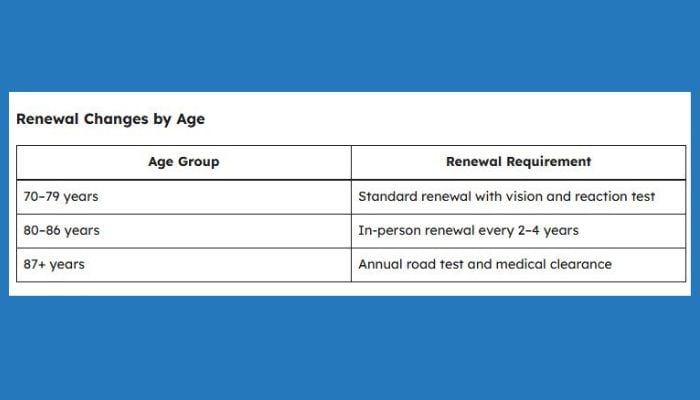
The new approach focuses on early detection of potential driving impairments and allows for a tailored evaluation rather than simply taking away a driver’s license.
Types of tests required:
Depending on individual’s health condition, older drivers might be asked to undergo one or more of the following tests:
Vision Test: To check whether the driver’s eyesight is sufficient for safe driving.
Cognitive Screening: To evaluate memory, reaction time, and decision-making skills.
Road Test: This may be required for those over 87 or if a doctor or family member expresses concerns.
Moreover, the new driving rules have introduced mandatory in-person renewal for senior drivers aiming to ensure that all necessary evaluations have been conducted.
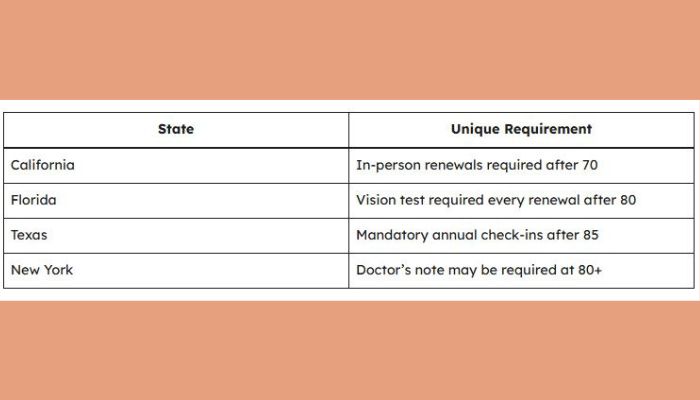
State by State Variation:
As the new policy is federal, each state will implement it differently, some states may require strict evaluation while others may take a relaxed approach. Here are few examples how rules may vary.
Restricted Licenses: A Safer Option
For seniors who are still capable of driving but may not be fit for all types of driving, restricted licenses may be offered. These licenses might come with conditions such as:
- Daytime driving only.
- Driving limited to local areas.
- No access to highways.
This approach helps seniors retain some independence while reducing potential safety risks.
Alternatives to Driving
If it becomes clear that driving is no longer safe for an individual, there are several alternatives available to maintain mobility such as:

- Ride-sharing services like Uber or Lyft.
- Community shuttle services and paratransit programs.
- Volunteer driver programs for seniors.
- Support from family and friends.
These options allow seniors to continue moving around without risking their safety or others on the road.
Who can report old drivers?
Family members, caregivers, and doctors have the option to report an older driver to the Department of Motor Vehicles (DMV), if they feel the driver may be unsafe on the road.

The DMV may then request a re-evaluation of the driver’s capabilities for taking any disciplinary action or issue a new license.


-
 Mayor Mamdani jumps into NYC pool to revive old tradition
 -
 Christopher Nolan slams Hollywood studios ahead of 'The Odyssey' release: 'I can do this'
 -
 Australian man arrested in Thailand following discovery of 17-year-old’s body in suitcase
 -
 Sheriff Chris Nanos breaks silence after claims about Savannah’s mother Nancy Guthrie video
 -
 Taylor Swift and Travis Kelce's wedding guest list revealed
 -
 New GTA 6 features confirmed: Dual protagonists, larger map, social feeds
 -
 Arrest warrant issued for Eminem’s ex-wife Kim Scott
 -
 Why Netflix’s expanded deal for Russian cartoon ‘ Masha and the Bear’ is sparking backlash in Ukraine