Search for survivors continues as Afghan quake death toll jumps to 1,411
Villagers join rescue efforts, using their bare hands to clear debris of simple mud and stone homes built into steep valleys
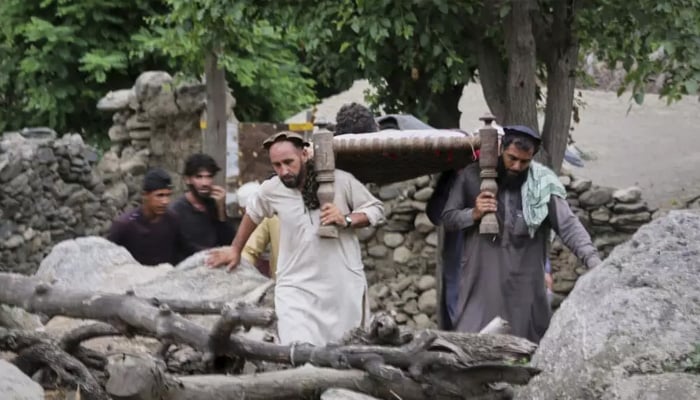
The death toll in the earthquake in Afghanistan, the worst in the region in years, has surged to 1,411, the Taliban administration's spokesperson said on Tuesday.
At least 3,251 people have been injured and more than 8,000 houses have been destroyed in the disaster, the group said.
Rescuers desperately searched for survivors in the rubble of homes flattened by an earthquake that struck eastern Afghanistan, killing more than 1,000 people.
The death toll in earthquake has risen to 1,124, the Afghan Red Crescent Society, a humanitarian group working in the region, said on Tuesday. At least 3,251 people have been injured and more than 8,000 houses have been destroyed in the disaster, the group said.
The 6.0-magnitude earthquake, followed by at least five aftershocks, hit remote areas in mountainous provinces near the border with Pakistan around midnight Sunday.
The head of the Kunar Provincial Disaster Management Authority, Ehsanullah Ehsan, told AFP that "operations continued throughout the night".
He said there were "still injured people left in the distant villages" in need of evacuation to hospitals.
Villagers joined the rescue efforts, using their bare hands to clear debris of simple mud and stone homes built into steep valleys.
Obaidullah Stoman, 26, who travelled to the village of Wadir to search for a friend, was overwhelmed by the level of destruction.
"I'm searching here, but I didn't see him. It was very difficult for me to see the conditions here," he told AFP.
"There is only rubble left."
The dead, including children, were wrapped in white shrouds by villagers who prayed over their bodies before burying them.
Some of the hardest-hit villages remain inaccessible due to blocked roads, the UN migration agency told AFP.
The earthquake epicentre was about 27 kilometres (17 miles) from Jalalabad, according to the USGS, which said it struck at a shallow eight kilometres below the Earth's surface.
After decades of conflict, Afghanistan is one of the poorest countries in the world, facing a protracted humanitarian crisis and the influx of millions of Afghans forced back to the country by neighbouring countries in recent years.
Since the Taliban seized power in 2021, foreign aid to the country has been slashed, undermining the impoverished nation's already hamstrung ability to respond to disasters.
The United States was the largest aid donor until early 2025, when all but a sliver of funds were cancelled after President Donald Trump took office.
In June, the United Nations said it was drastically scaling back its global humanitarian aid plans due to the "deepest funding cuts ever".
On Monday, the UN Secretary-General Antonio Guterres said in a statement it was working with authorities to "swiftly assess needs, provide emergency assistance and stand ready to mobilise additional support", and announced an initial $5 million.
Shallow quakes cause more damage
Taliban authorities in a provisional toll reported 800 dead and 2,500 injured in Kunar province, as well as 12 dead and 255 injured in Nangarhar.
Laghman province also has dozens of injured, according to government spokesman Zabihullah Mujahid.
Relatively shallow quakes can cause more damage, especially since the majority of Afghans live in low-rise, mud-brick homes vulnerable to collapse.
Many living in quake-hit villages were among the more than four million Afghans who have returned to the country from Iran and Pakistan in recent years.
"There is a lot of fear and tension... Children and women were screaming. We had never experienced anything like this in our lives," Ijaz Ulhaq Yaad, a member of the agricultural department in Nurgal, told AFP on Monday.
In a post shared by the Vatican, Pope Leo XIV said he was "deeply saddened by the significant loss of life" caused by the quake.
Afghanistan is frequently hit by earthquakes, especially in the Hindu Kush mountain range, near the junction of the Eurasia and India tectonic plates.
In October 2023, western Herat province was devastated by a 6.3-magnitude earthquake, which killed more than 1,500 people and damaged or destroyed more than 63,000 homes.
A 5.9-magnitude quake struck the eastern province of Paktika in June 2022, killing more than 1,000 people and leaving tens of thousands homeless.


-
 Crow flocks over Israel spark conspiracy theories
 -
 Former UK MP Crispin Blunt pleads guilty to crystal meth possession case
 -
 Inside Trump’s 15-point plan: Global stocks climb as oil falls on hopes of Iran peace deal
 -
 Savannah Guthrie adopts new strategy in search of her missing mother Nancy
 -
 Is world heading toward global recession in 2026? Larry Fink warns of looming risk
 -
 Nanaimo weather improves as BC lifts flood advisories following days of heavy rainfall
 -
 Denmark election: Frederiksen faces tough coalition negotiations after losing majority
 -
 Brian Nathan wins close Florida Senate race with recount possible after narrow lead
-
 National Hurricane Centre updates forecast cone to improve storm tracking and warnings for 2026
 -
Canada federal minimum wage increase confirmed with new $18.15 rate starting April 1
-
Jyoti Gondek named in RCMP probe as warrants executed in Calgary City Hall investigation
-
Emily Gregory secures major win in Florida as Democrats flip Trump's Mar-a-Lago district