Google unveils AI tool to revive lost Roman inscriptions
Google research lab DeepMind has developed AI tool to restore ancient texts
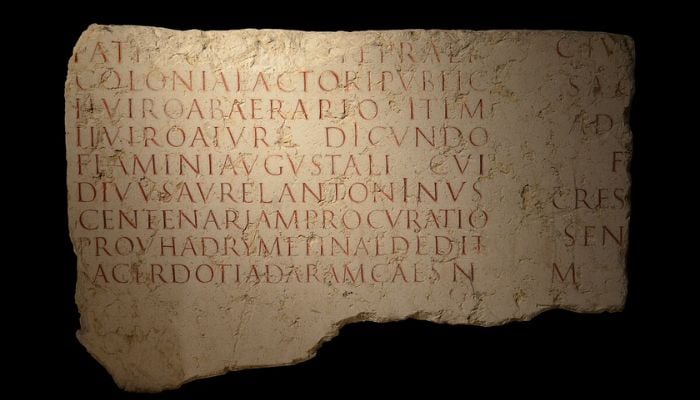
Artificial Intelligence (AI) is set to revolutionize the course of archaeology. In this regard, Google’s AI research lab DeepMind has introduced a new AI model, aiming to ease the process of contextualizing ancient Latin inscriptions.
Named “Aeneas" after the mythical Trojan hero, the first of its kind AI system predicts where and when inscriptions were made and offers the suggestions for the missing words or texts. Initially, the model is trained on the database of nearly 200,000 known inscriptions, amounting to 16m characters.
How does the new model work?
Aeneas can easily search for texts that share similarities in wording, standardized formulas and syntax across the thousands of Roman inscriptions.
It can further process multimodal input and fill the inevitable gaps in texts, worn and damaged artefacts through deeper historical connections.
Having trained on the rich collection of inscriptions, AI can perform the two key functions. First, it can assign study texts to one of 62 Roman provinces and estimate its creation date within 13 years. Second, it delivers suitable words for textual reconstruction as this feature has been tested on already known inscriptions.
'Aeneas' through the Historians' lens
Professor Dame Mary Beard of Cambridge University has described this tool as potentially “transformative”. She further explained: “Breakthroughs in the very difficult field have tended to rely on the memory, the subjective judgement and the hunch of scholars. Aeneas opens up new horizons entirely.”
Although inscriptions are the most significant records in the ancient world, deciphering these records is quite an uphill task.
According to Dr Thea Sommerschield, a historian at the University of Nottingham who developed Aeneas with the tech firm, “Aeneas helps historians interpret, attribute and restore fragmentary Latin texts. That’s the grand challenge that we set out to tackle.”
Jonathan Prag, co-author and professor of ancient history at the University of Oxford explained that Aeneas would also be viable for a wide range of people to work on the various texts.
"The only way you can do it without a tool like this is by building up an enormous personal knowledge or having access to an enormous library. But you need to be able to use it critically," Jonathan elucidated.
Related: Artificial General Intelligence is not guaranteed, here’s why


-
 Downing Street leak raises questions over Burnham’s next move
 -
 Mike Tyson reflects on infamously biting Evander Holyfield's ear
 -
 Trump set to host tech CEOs at state dinner for Xi Jinping: What to know
 -
 Millie Bobby Brown, Jake Bongiovi welcome another child together
 -
 Jung Ho-yeon reveals what inspired her ‘Hope’ role
 -
 Joanne Sheen’s remains identified seven years after she went missing
 -
 Macklemore removal called 'censorship by billionaire Epstein club'
 -
 Andy Burnham sends strong message on UK’s net zero target