
Scientists melt 1.5m year-old ice to unlock Earth’s climate secrets
Earth's oldest ice core holds answers to our climate future
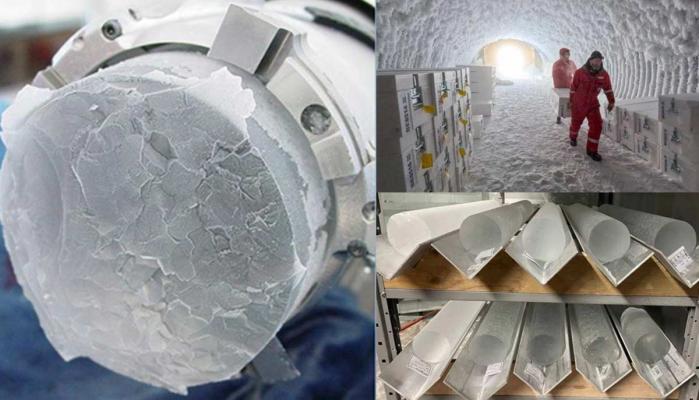
Scientists found ancient ice cores that hold the mysteries of the past and possibly future climate change.
A rare cylinder was drilled from Antarctica and is estimated to be more than 1.5 million years old.
Named as a “time capsule”, the ice core was transported to the British Antarctic Survey (BAS), Cambridge from Antarctica in a highly controlled environment.
Scientists claim that this ice cylinder may be holding traces of ancient dust, volcanic ash, and microscopic marine organisms that can metamorphose our understanding of climate shifts in the past and what they can indicate for the future.
This research will be led by Dr. Liz Thomas who is the head of ice core research at BAS.
While sharing views with the BBC, Dr. Liz Thomas shared: “This is a completely unknown period of our Earth’s history.”
The block of ice was extracted from nearly 2.8km below the surface and can be capable enough to hold evidence from a time when carbon dioxide levels were high or higher than are today.
Currently, it is being stored in a -23°C freezer with warning lights and a built-in emergency escape tunnel. Scientists claim that the ice is so pristine that they can see their hands through it.
Unlocking the past to predict the future
The research will take place in the next seven weeks where the team will slowly melt the ice. The analysis being conducted will reveal the results of gases, dust, and isotopes that will further lead to reconstruct wind patterns, temperatures, and sea levels from up to 1.5 million years ago.
One prominent mystery that scientists are hopeful to resolve is the Mid-Pleistocene Transition. The mystery revolves around a substantial shift that happened 800,000 to 1.2 million years ago when Earth’s ice age cycle suddenly lengthened from 41,000 to 100,000 years. According to Dr. Thomas: “This is one of the most exciting unsolved questions in climate science.”
A global effort
Alongside the UK, the sections of the ice are also transported to Germany and Switzerland to conduct parallel research. James Veal, one of the core engineers who helped to extract the ice, described it as an “amazing feeling” knowing it held secrets from a time before the existence of humans.
The findings from the study will help to provide critical insights into how Earth responds to high carbon dioxide levels leading to predict the long-term impacts of today’s global warming. As mentioned by Dr. Thomas, “Our climate system has been through so many changes we need to understand them to prepare for what’s coming.”
With advanced instruments such as mass spectrometers, researchers will investigate volcanic traces, sea salts, and rare elements, piecing together a story written in ice over millennia, one that may hold urgent lessons for humanity’s future






-
 Kylie Kelce reveals why she barely planned her wedding day?
 -
 Paul Anthony Kelly opens up on 'nervousness' of playing JFK Jr.
 -
 'Finding Her Edge' creator explains likeness between show and Jane Austin novel
 -
 How AI boyfriends are winning hearts in China: Details might surprise you
 -
 James Van Der Beek's final days 'hard to watch' for loved ones
 -
 Will Smith, Jada Pinkett's marriage crumbling under harassment lawsuit: Deets
 -
 Khloe Kardashian reveals why she slapped ex Tristan Thompson
 -
 Taylor Armstrong walks back remarks on Bad Bunny's Super Bowl show