Trump signals fresh trade tensions with China
US Treasury Secretary Scott Bessent says trade talks with China are "a bit stalled"
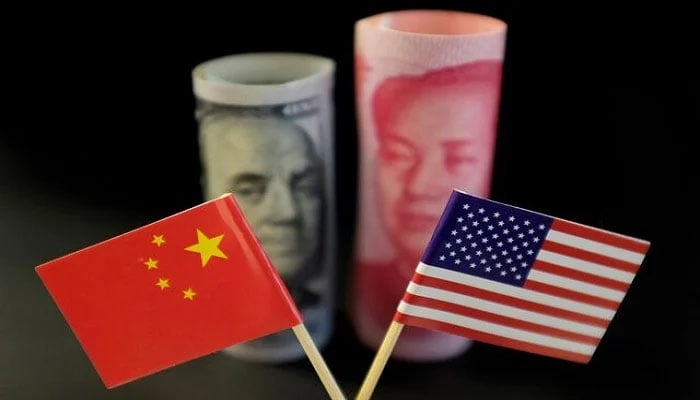
US President Donald Trump signaled renewed trade tensions with China on Friday, arguing that Beijing had "violated" a deal to de-escalate tariffs, at a time when both sides appeared deadlocked in negotiations.
Trump’s post on his Truth Social platform came hours after US Treasury Secretary Scott Bessent said that trade talks with China were "a bit stalled," in an interview with broadcaster Fox News.
The world’s two biggest economies had agreed this month to temporarily lower staggeringly high tariffs they had imposed on each other, in a pause to last 90 days, after talks between top officials in Geneva.
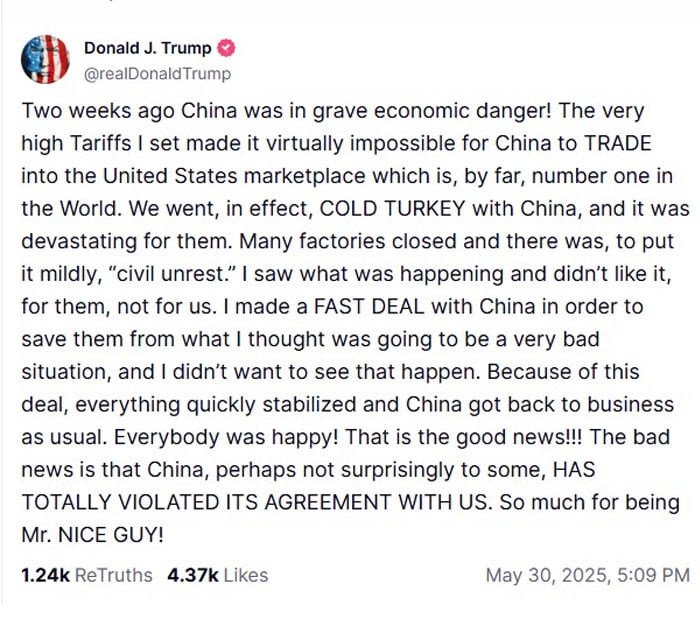
But on Friday, Trump wrote that: "China, perhaps not surprisingly to some, HAS TOTALLY VIOLATED ITS AGREEMENT WITH US," without providing further details.
Asked about the post on CNBC, US Trade Representative Jamieson Greer took aim at Beijing for continuing to "slow down and choke off things like critical minerals."
He added that the United States’ trade deficit with China "continues to be enormous," and that Washington was not seeing major shifts in Beijing’s behavior.
On Thursday, Bessent had suggested that Trump and his Chinese counterpart Xi Jinping could get involved in the situation.
He said there could be a call between both leaders eventually.
Since Trump returned to the presidency in January, he has imposed sweeping tariffs on most US trading partners, with especially high rates on imports from China.
New tit-for-tat levies from both sides reached three digits before the de-escalation earlier this month, where Washington agreed to temporarily reduce its additional tariffs on Chinese imports from 145% to 30%.
China, meanwhile, lowered its added duties from 125% to 10%.
The US tariff level remains higher as it also includes a 20% levy that the Trump administration recently imposed on Chinese goods over the country’s alleged role in the illicit drug trade — an issue that Beijing has pushed back against.
The high tariff levels, while they were still in place, forced much trade between both countries to grind to a halt, as businesses paused shipments to try and wait for both governments to reach an agreement to lower the levies.
Trump’s tariff plans are also facing legal challenges.
A trade court ruled this week that the president overstepped his authority in tapping emergency economic powers to justify sweeping tariffs.
It blocked the most wide-ranging levies since Trump returned to office, although this ruling has since been put on hold for now as an appeals process is ongoing.
The ruling left intact, however, tariffs that the Trump administration imposed on sector-specific imports such as steel and autos.


-
 Australia launches urgent AI governance review after OpenAI Medicare hack
 -
 Judge blocks Trump’s White House media ban, restores access
 -
 US-China trade truce extended as Trump greets Xi for high-stakes state summit
 -
 Theranos founder Elizabeth Holmes approved for halfway house move next year
 -
 Australia says OpenAI AI agent hacked government system, but informed months later
 -
 Savannah Guthrie made desperate plea in throwback post: ‘We need you’
 -
 Why did Patrick Clancy's marriage 'end so quickly'?
 -
 UK joins EU ocean monitoring programme as extreme weather risks grow