
This is what 'Christmas gift' from space discloses
Surprising "Christmas gift" from space has been linked with mystery of JuMBOs
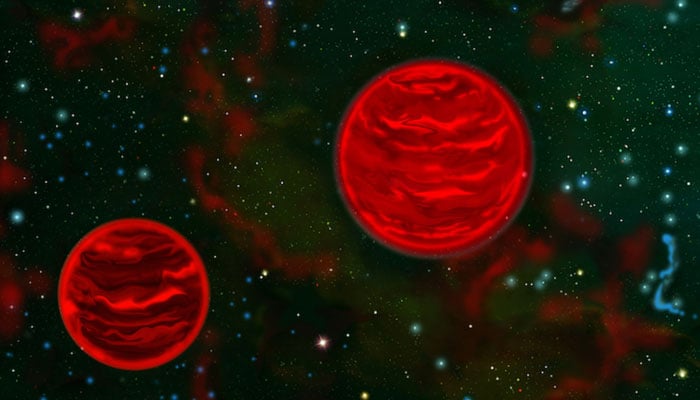
A surprising Christmas gift has been received by the scientists this year in the form of a potential solution to the mystery of JuMBOs, which are strange celestial objects that seem not to be planets or stars.
According to Space.com, the mysterious JuMBOs (Jupiter-mass binary objects) are believed to actually be stellar cores by a team of researchers. These cores have been violently "unwrapped" by massive, powerful stars similar to kids excitedly unwrapping presents on Christmas Day.
This finding can potentially solve a mystery that arose in 2023.
In the Orion Nebula Cluster, 42 pairs of these free-floating planetary-mass objects were discovered by astronomers using the James Webb Space Telescope (JWST).
Because they weren't associated with a star and had somehow managed to stay in binary pairs, the astronomers were confused.
Creating quite the conundrum, this suggested that JuMBOs didn't form like planets or stars.
Led by Richard Parker of the University of Sheffield and undergraduate student Jessica Diamond, the team that devised this idea to explain JuMBO formation did so by revisiting an old idea to explain this phenomenon.
"We are using quite an old idea — that radiation from massive stars is so strong it erodes the gas 'core' that eventually forms a star," Parker told Space.com.
"The radiation removes some of the material from the core, reducing its mass, but also compressing the remaining material so that it efficiently forms a low-mass object,” he added.
The fact that stars commonly form in binary systems was used by the team revisiting a paper published exactly 20 years ago. They then applied the photo erosion framework to demonstrate that a stellar binary could be photo-eroded to form a JuMBO pairing.





-
 Shanghai Fusion ‘Artificial Sun’ achieves groundbreaking results with plasma control record
 -
 Polar vortex ‘exceptional’ disruption: Rare shift signals extreme February winter
 -
 Netherlands repatriates 3500-year-old Egyptian sculpture looted during Arab Spring
 -
 Archaeologists recreate 3,500-year-old Egyptian perfumes for modern museums
 -
 Smartphones in orbit? NASA’s Crew-12 and Artemis II missions to use latest mobile tech
 -
 Rare deep-sea discovery: ‘School bus-size’ phantom jellyfish spotted in Argentina
 -
 NASA eyes March moon mission launch following test run setbacks
 -
 February offers 8 must-see sky events including rare eclipse and planet parade