Chinese scientists simulate black holes via quantum computing
A black hole is an area of space where gravity is so intense that even light cannot escape
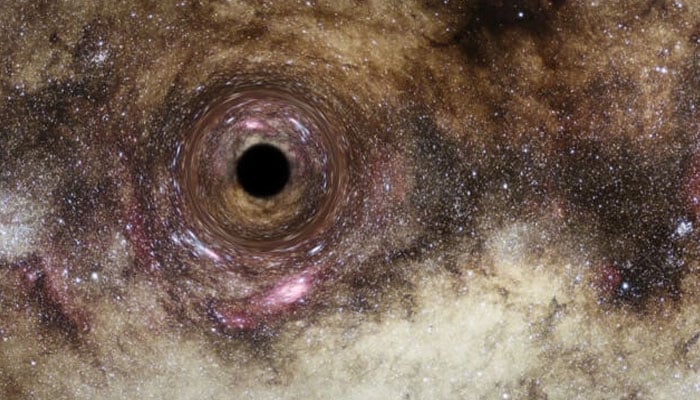
Stephen Hawking, the legendary astrophysicist, made waves in the field of science with his findings about black holes, and to this day, those findings are helping scientists take a step closer to finding more answers about these mysterious cosmic bodies.
Recently, a team of scientists led by Chinese researchers suggested that the physics of black holes has reportedly been modelled using quantum computing.
According to the researchers, the Hawking radiation experiments paved the way for superconducting quantum chips to simulate the quantum effects of black holes and represented "a step towards building quantum systems with properties similar to those of black holes."
A black hole is an area of space where gravity is so intense that even light cannot escape. It is impossible to escape once a particle enters a black hole's horizon because the horizon forbids the particle from turning around, the South China Morning Post reported.
The team discovered that quantum effects cause particles inside black holes to escape, releasing Hawking radiation, which causes the black hole to lose energy and disintegrate.
"This newly constructed analogue black hole then facilitates further investigations of other related problems of the black hole," the researchers from the Chinese Academy of Sciences, Tianjin University, the Beijing Academy of Quantum Information Sciences, and the RIKEN Cluster for Pioneering Research in Japan said in their findings published in the peer-reviewed journal Nature Communications this month.
According to the team, it was challenging to test these effects through experiments because they were so weak, despite the fact that it was challenging to directly observe the quantum effect of a genuine black hole in astrophysics.
In recent years, experiments utilising optical metamaterials, light, Bose-Einstein condensates, which is a state of matter where all of the constituent particles are at their lowest energies, shallow water waves, and condensed matter have all been conducted to test the theory.
In the most recent experiment to observe analogue Hawking radiation, the group created a superconducting processor made up of a chain of 10 qubits with interaction couplings controlled by nine tunable couplers.
The Chinese Academy of Sciences' Institute of Theoretical Physics claims that quasiparticles inside analogue black holes radiate through the event horizon, satisfying Hawking radiation properties. Measurements of qubits outside the horizon confirm this behaviour.
"Our results would stimulate more interest in exploring the related features of black holes using a programmable superconducting processor with tunable couplers," the team wrote.


-
 Google DeepMind maps 9 billion human DNA mutations in major genetics breakthrough
 -
 'New' frog species discovered after hiding in plain sight for 100 years
 -
 Elon Musk, SpaceX eyes 1 million satellites for orbital data centers
 -
 Small asteroid to create fireball over ocean near Australia today: What to know
 -
 AI model flags possible cyclone near Hong Kong
 -
 First private rocket reaches orbit from Continental Europe as Isar Aerospace launches Spectrum
 -
 49 years of Voyager 1: The epic journey that took us beyond the solar system
 -
 Earth's next supercontinent could trigger mass extinctions, says scientists