
Phew! Truck-sized asteroid misses Earth
The rock, which was spotted for first time on Saturday by amateur stargazer in Crimea, came closest to southern tip of South America at around 0029 GMT Friday
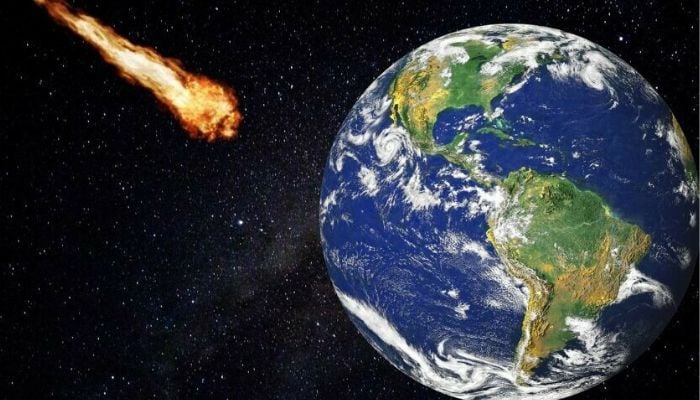
A truck-sized asteroid that suddenly loomed out of the darkness a few days ago — with the Earth in its sights — sailed harmlessly past us on Thursday, space scientists said.
Despite what we've seen in movies like "Armageddon," no global mission to blow it up or knock it off course with nuclear weapons was required.
Instead, Asteroid 2023 BU whizzed past without incident and back out into the blackness of space. Phew.
The rock, which was spotted for the first time on Saturday by an amateur stargazer in Crimea, came closest to the southern tip of South America at around 0029 GMT Friday, according to scientists who were tracking it.
At its nearest point, the asteroid was just 2,200 miles (3,600 kilometres) from Earth's surface — just a quarter of the height of many of the geostationary satellites that make our telephones and car navigation systems work, AFP said.
Amateur astronomer Gennadiy Borisov, who had already spotted an interstellar comet in 2019, raised the alarm over the weekend, alerting fellow space-watchers to the previously unknown celestial body.
Scientists around the world raced to calculate where it was headed — and whether we needed to start making last-minute evacuation plans.
But experts using NASA's Scout impact hazard assessment system rapidly determined the alien visitor was coming in peace.
"Scout quickly ruled out 2023 BU as an impactor, but despite the very few observations, it was nonetheless able to predict that the asteroid would make an extraordinarily close approach with Earth," said NASA's Davide Farnocchia, who helped develop Scout.
"In fact, this is one of the closest approaches by a known near-Earth object ever recorded."
If the math had been off, however, humanity would still probably have been alright, scientists say.
At between just 3.5 to 8.5 metres (11 to 28 feet) across, Asteroid 2023 BU is a bit small to cause too much damage, and would have largely burned up as it hurtled through the atmosphere.
The few meteorites that did make it to the ground would have been small, not the city-destroying, tsunami-generating monsters of "Deep Impact."
The close call will leave a more lasting impact on the asteroid itself, NASA's number-crunchers said.
Earth's gravity will affect the object's orbit, lengthening the amount of time it takes for 2023 BU to go around the Sun, from 359 days to a more leisurely 425 days.






-
 Dutch seismologist hints at 'surprise’ quake in coming days
 -
 SpaceX cleared for NASA Crew-12 launch after Falcon 9 review
 -
 Is dark matter real? New theory proposes it could be gravity behaving strangely
 -
 Shanghai Fusion ‘Artificial Sun’ achieves groundbreaking results with plasma control record
 -
 Polar vortex ‘exceptional’ disruption: Rare shift signals extreme February winter
 -
 Netherlands repatriates 3500-year-old Egyptian sculpture looted during Arab Spring
 -
 Archaeologists recreate 3,500-year-old Egyptian perfumes for modern museums
 -
 Smartphones in orbit? NASA’s Crew-12 and Artemis II missions to use latest mobile tech