China's capital adjusts to life with COVID after policy reversal
China is now steeling for wave of infections expected to follow relaxation of rules — with one previous estimate suggesting more than million people could die
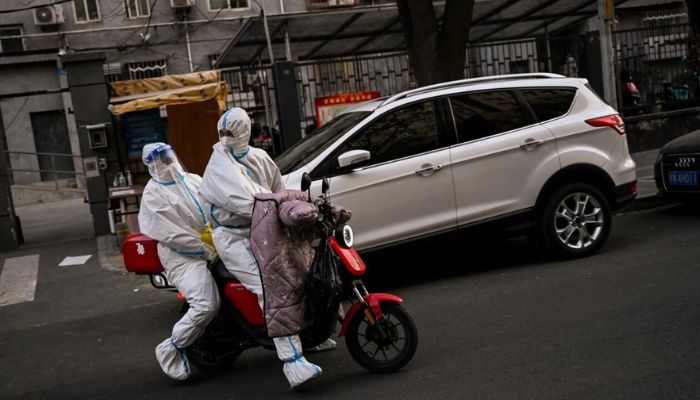
BEIJING: The Chinese capital showed tentative signs of a return to normal Thursday after a sudden reversal of a hardline pandemic policy that hammered the world's second-biggest economy and ignited rare protests.
Beijing's National Health Commission (NHC) on Wednesday announced a nationwide loosening of its zero-COVID restrictions, reducing the scope of mandatory testing, allowing some positive cases to quarantine at home, and ending large-scale lockdowns.
A major relaxation of President Xi Jinping's flagship pandemic policy, the country's top health body said the shift in tactics was intended to help the country "keep abreast of the changing times".
In the capital, where a surge in cases had forced many to stay at home and kept businesses and schools shut, traffic was back to about half its usual intensity on Thursday, an AFP journalist said.
Under the new guidelines, the frequency and scope of PCR testing — long a tedious mainstay of life — have been reduced.
But while the number of testing stands around Beijing has decreased, those that remain are still busy, with many workplaces continuing to require negative tests.
"I've come for a test because someone in my office has tested positive. I hope I haven't caught Covid," 28-year-old Chen Min, wrapped in a down jacket, told AFP.
Others said they had come to be tested because they work in the hotel and catering industry, where testing remains obligatory.
Zhang Lan, a food delivery driver, said he needed to be tested because "it's a request from the company" to avoid contaminating customers.
At a nearby shopping centre, businesses were open but crowds were sparse, with guards checking visitors' health codes though no longer requiring negative COVID tests.
'Very quiet'
"It's very quiet. I think people are still afraid to go out," the manager of a Starbucks said.
China is now steeling for a wave of infections expected to follow the relaxation of the rules — with one previous estimate suggesting more than a million people could die.
At one fever clinic in Beijing's Chaoyang district, an AFP reporter saw lines that snaked around the block.
And in another part of the capital, AFP saw a steady stream of customers going into a local pharmacy for cold and fever medicine.
"But we're out of stock of this type of medicine. We don't even have any Vitamin C left," Sun Qing, an employee, said.
She added that, over the past few days, people had been buying up the drugs in anticipation of a policy easing.
"Some of them unfortunately took much more than they needed. It could be enough for a year!" she exclaimed.


-
 Zelenskyy signals new Russian refinery strikes after feeling ‘betrayed’ by Trump
 -
 Anthropic to add official US voting information to Claude ahead of midterms
 -
 University of Chicago investigates reported sexual assault at off-campus fraternity house
 -
 Tumbler Ridge school shooting: US grand jury indicts alleged accomplice indicted
 -
 Trump targets Canada again with 51st state remarks at Arizona rally
 -
 Alberta separation referendum draws massive early turnout as 174,532 cast ballots
 -
 Jared Kushner sued over government role and alleged conflicts of interest
 -
 Brazil ends six-day workweek in historic labour reform affecting 30 million workers
-
 Zelenskyy says Ukraine is losing a strong US partner amid Starlink restrictions
 -
Did Katie Zacharia pass the bar? Trump's new press secretary faces scrutiny
-
Ilhan Omar's phone seized by federal authorities weeks before US midterm elections
-
Nancy Mace's ex-fiancé Brendan Bryant charged with voyeurism after 2025 allegations